

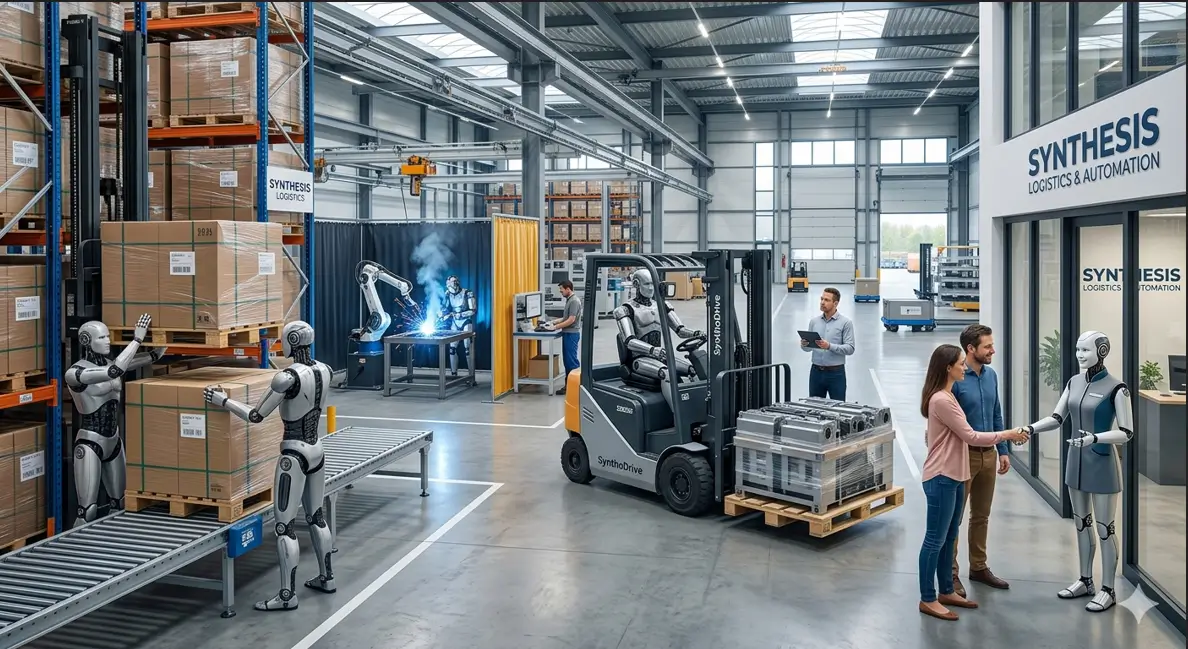
Across manufacturing, logistics, food processing, and healthcare, the decision to automate is no longer a future agenda item. It is a current operational priority. Robotics equipment financing has moved to the top of the CFO’s capital planning list, and for good reason.
Labor shortages are structural. Demand for throughput, consistency, and speed is accelerating. The competitive gap between companies that have automated and those that haven’t is widening every quarter.
The technology is ready. The business case is clear. The problem, for many companies, is the capital.
Traditional banks want to help. But robotics and automation equipment don’t fit their collateral models. The result is a response most CFOs recognize: “We like your business, but we can’t get comfortable with this equipment.”
That response has nothing to do with your creditworthiness. It has everything to do with how banks are built.
Equipment Leases is a bank-complementary direct lender and wholly owned subsidiary of Commercial Funding Partners. We finance revenue-generating equipment the way it actually works, including 100% of the project cost, from hardware to installation to integration. Whether you come to us directly or your bank refers you, your project moves forward.
The industry’s momentum is unmistakable. The Automate 2026 show in Chicago, coming up in June, features over 1,000+ exhibitors, a real-time measure of how fast this space is moving. Your capital strategy needs to move just as fast.
Why Automation Has Become a Strategic Imperative
The pressures driving companies toward automation are structural, not cyclical.
Labor shortages are not resolving. Recruiting, training, and retaining skilled floor workers costs more every year. Demand for production speed and output consistency is rising. Margin pressure is tightening. And competitors who have already automated are pulling ahead quarter by quarter.
Automation addresses all of this simultaneously. It increases throughput. It reduces labor dependency. It improves quality and consistency across every shift. And it creates a scalable production model structured for growth, not constrained by headcount.
Buddy Zarbock, CEO of Commercial Funding Partners, our strategic partner, frames it plainly: “We’re private, business-to-business lenders helping companies across the U.S. expand, modernize, and grow. If they need new manufacturing lines, construction equipment, or even aircraft engines, we make it happen.”
When we evaluate an automation financing request, we are not looking at the asset in isolation. We are looking at what it produces, what it enables, and what it costs the business to delay.
The range of automation assets companies are financing today is broad. Each category serves a distinct operational need:
- Autonomous Mobile Robots (AMRs): Self-navigating units that move materials through warehouses and production floors without fixed infrastructure
- Collaborative Robots (Cobots): Designed to work alongside human workers in shared spaces, handling repetitive or precision tasks
- Automated Guided Vehicles (AGVs): Fixed-path material handling systems widely used in logistics and manufacturing
- SCARA Robots: High-speed, precise systems built for assembly, packaging, and pick-and-place operations
- Articulated Robots: Multi-joint arms capable of welding, painting, and complex assembly across heavy manufacturing environments
- Humanoid Robots: Emerging category designed for general-purpose tasks in human-oriented workspaces
- Hybrid Systems: Integrated platforms combining multiple robotics technologies within a single workflow
The business case for automation is clear. The financing path is where complexity begins.
Why Traditional Banks Struggle to Finance Robotics Equipment
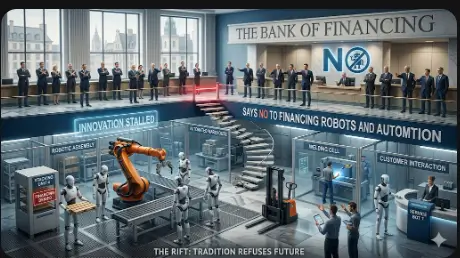
Banks are not indifferent to financing for automation equipment. Most are actively trying to help their clients grow. The challenge is structural. Their underwriting models were built around assets with established collateral profiles, predictable depreciation curves, and liquid secondary markets. Robotics and automation equipment do not fit that framework, and no amount of goodwill on the banker’s part changes the underlying credit model.
Understanding exactly where the friction comes from helps you plan around it.
Specialized Equipment, Uncertain Collateral
Traditional bank lending is collateral-driven. To assign a loan-to-value ratio to an asset, a bank’s credit team needs established secondary market data:
- Auction records
- Resale comparables
- Liquidation benchmarks
For a fleet of trucks or a CNC milling machine, that data exists. For a custom-configured robotic assembly cell integrated into a specific production workflow, it largely does not. The asset has real value within the operation for which it was built. Outside of it, its market value is difficult to establish and often significantly lower than its installed cost.
Banks see that gap and respond accordingly. The result is a collateral shortfall that strong financials alone cannot overcome within a traditional credit model.
Our president, Traci Dolphin, sees this from the other side of the underwriting table every day. Her approach starts from a different premise: “If the equipment is revenue-generating and will help a company expand, that’s exactly the kind of deal we want to finance.”
That distinction, collateral value versus revenue-generating capacity, is the fundamental difference between how banks and Equipment Leases evaluate the same asset.
Rapid Technological Change
Robotics and automation technology evolve quickly:
- New software platforms emerge regularly
- Improved hardware generations follow short development cycles
- More efficient system architectures can render prior models outdated before a loan term ends
For a bank holding a five-year loan on specialized automation equipment, that pace of change creates a real exposure risk. If a borrower defaults in year three, the collateral may have depreciated faster than the loan balance. Banks manage that risk by tightening terms, requiring larger down payments, or declining the transaction altogether. It is a rational response within their model. It also leaves well-qualified borrowers without a financing path.
Complex ROI Calculations
The return on an automation investment is real, but it is rarely expressed in the standardized cash flow metrics that traditional underwriting prefers. The benefits are meaningful:
- Labor cost savings
- Throughput increases
- Error rate reductions
- Improved production margins
The problem is that automation ROI often involves a ramp-up period before the full benefit materializes. Banks prefer historically documented revenue streams they can project forward with confidence. That mismatch creates friction in underwriting.
Equipment Leases structures financing around how automation projects actually perform. Payment structures can be aligned with production ramp-up timelines, so obligations scale with the revenue the equipment generates, not the date the invoice was funded.
Regulatory and Credit Constraints
Banks operate within a tightly regulated capital framework. The constraints are not discretionary, they are binding:
- Federal Reserve requirements
- Risk-weighted asset rules
- Regulatory exposure caps per borrower
When a bank declines a robotics financing request, it is often not a credit judgment about the borrower. It is a structural limitation on what the institution is permitted to hold on its balance sheet. This is the context behind the exposure cap conversation many CFOs have experienced: a bank that genuinely wants to support a client’s growth but has reached the limit of what its regulatory framework allows it to approve.
Equipment Leases, as a non-bank direct lender, isn’t bound by the reserve requirements or per-borrower limits that constrain banks. That flexibility lets us structure around the gap a bank can’t fill, working alongside it rather than replacing it.
Integration and Implementation Risk
Automation is not a single purchase. It is a project. Between equipment delivery and full operational output sits a series of execution stages:
- Installation and physical setup
- System integration with existing workflows
- Employee training and change management
- Production ramp-up to full capacity
That gap, between when the asset is funded and when it is generating full return, represents execution risk that traditional lenders are not structured to absorb. Banks fund based on the assets at rest.
Equipment Leases funds based on the project in motion. Progress funding structures release capital in phases aligned with installation and commissioning milestones, so the financing matches how the deployment actually unfolds.
The Real-World Financing Gap and What It Costs You
The financing gap has a real business cost. Every quarter a company delays its automation upgrade is a quarter of lost productivity, contracts it could not win, and competitive ground it cannot recover.
A real example: $9M, 60 days, new contracts
A Florida manufacturer had been running food-related FDA production equipment for over a decade. Maintenance costs had climbed past the point where replacement was the smarter decision. Newer contracts in their market required the latest equipment. Without an upgrade, those contracts were out of reach.
Their financials told a harder story. An extended operational closure had made them technically unbankable under traditional lending standards.
Traci Dolphin led the underwriting. The deal required a creative structure, one that looked beyond the impaired financials to the owner’s broader business interests to establish a viable credit basis.
The result: a $9M equipment upgrade, funded in approximately 60 days.
The client came away with new equipment, restored competitive positioning, and contracts they could now win.
That is what bank-complementary equipment lending looks like in practice. Whether a company comes to us directly or a bank refers them, the project moves forward.
How Equipment Leases Finance Robotics and Automation Projects
Most lenders describe their financing programs in general terms. We will describe ours specifically, because the details are where automation financing either works for a business or falls apart.

100% project financing, including soft costs
When we say 100% equipment financing, we mean the entire project, not just the hardware sitting on the floor.
A robotics or automation deployment involves more than the equipment itself. Installation, system integration, employee training, and software implementation are all part of bringing the asset into operation. Banks typically exclude these soft costs from financing, requiring the borrower to cover them out of pocket.
Equipment Leases finances all of it. Hardware, installation, integration, training, and associated soft costs are bundled into a single structured payment. No out-of-pocket surprises. No separate funding line for implementation. One structure, one monthly payment, full project covered.
Progress funding for phased deployments
Large automation projects are rarely funded in a single transaction. Equipment is ordered from multiple vendors, built to specification, shipped, and installed in stages. Each stage requires payment before the next begins.
Progress funding is how we structure financing to account for that reality. Rather than releasing capital as a lump sum, funds are disbursed in phases tied to installation and commissioning milestones. Each phase is funded as it is completed. The borrower does not need to front deposits or milestone payments out of operating cash.
We fund projects in ways that allow companies to conserve cash, through 100% financing, milestone payments, and flexible structures that match real-world needs.
For multi-vendor automation projects and phased robotic cell deployments, progress funding is not a workaround. It is the correct structure.
Flexible lease structures built for automation
Automation equipment leasing is not one-size-fits-all. The right structure depends on how the asset will be used, how it will be accounted for, and how the company plans to grow.
We offer two primary lease structures:
- Dollar-out capital lease: The borrower makes fixed payments over the lease term and takes ownership of the equipment at the end for one dollar. The asset stays on the balance sheet throughout. For companies planning to claim Section 179 deductions or bonus depreciation on automation equipment, this structure is typically the relevant vehicle. Always consult a CPA or tax advisor to confirm eligibility and timing.
- FMV operating lease: Monthly payments are lower because the borrower is not paying toward ownership. At the end of the term, they can return the equipment, renew, or purchase it at fair market value. For fast-evolving automation assets where technology refresh matters, this structure preserves flexibility.
Beyond the lease type, payment timing can be structured to match how the automation investment performs:
- Deferred payments: No payments during installation and ramp-up. Obligations begin once the system is operational.
- Step payments: Payments start lower and increase over time, aligned with the productivity gains the equipment generates.
- Master lease: For companies adding automation in phases, a master lease allows additional equipment to be added under the same structure with minimal new documentation. Adding a second robotic cell in Q2 does not require starting the financing process from scratch, only a one-page request.
Same-day credit decisions
Speed in automation financing is not just a convenience. It is a competitive variable. Projects have vendor payment schedules, installation windows, and production timelines that do not wait for a slow approval process.
Our credit committee is intentionally lean. Our structure is very flat. The finance committee is only three or four members, and we can make decisions the same day when needed.
That structure exists by design. It is how we deliver same-day credit decisions without sacrificing underwriting discipline.
The process begins with a 7-minute online application. Once we get all the documents we need, it’s a quick turnaround; our team works fast.
Preparation is the variable that determines speed. Borrowers who come with clean financials, a clear project scope, and organized documentation move through our process the fastest.
Explore Other Industries We Finance
The Tax Efficiency Angle, What CFOs Should Know
The lease structure decision has tax implications that are worth planning around before the application is submitted.
For companies financing automation through a dollar-out capital lease, the equipment is treated as owned for tax purposes. That generally makes it eligible for Section 179 deductions or bonus depreciation on the equipment value, up to applicable limits, potentially in Year 1. For a significant automation investment, that treatment can meaningfully reduce taxable income in the year the equipment goes into service.
For companies choosing an FMV operating lease, lease payments are generally deductible as an operating expense. For fast-evolving automation assets where technology refresh flexibility matters at end of term, this structure carries its own financial logic.
The structured conversation should happen before the deal is structured, not after. We work with clients to align lease type with both their operational needs and their tax planning goals. Your CPA or tax advisor should confirm eligibility and timing before making any decision on tax treatment.
Buddy Zarbock has engaged with this issue directly at the federal level: “Our political action work in Washington, D.C., helped advocate for business-friendly policies like the continuation of bonus depreciation. I’m proud to have been part of that effort.”
For a deeper look at how these deductions apply to equipment financing, see our related resources:
Section 179 and Equipment Financing and Bonus Depreciation and Equipment Leasing
Automation as a Capital Efficiency Strategy
The most forward-thinking companies investing in automation are not just solving an operational problem. They are making a deliberate capital allocation decision.
The choice to finance rather than purchase outright is not a concession to cash constraints. For a CFO managing growth responsibly, it is the smarter structure. A large automation investment funded through equipment financing:
- Converts a one-time capex event into a predictable monthly operating expense
- Keeps working capital intact for inventory, hiring, and market opportunities
- Allows cash reserves to remain available where they generate the most return
- Let the automation system begin delivering productivity gains from day one
The payment structures we build are designed specifically around how automation projects perform in production environments. Each option exists because automation investments deliver value gradually and operationally, not all at once:
- Deferred payments: No obligations during installation and ramp-up. Payments begin once the system is producing.
- Step payments: Obligations grow as throughput increases, aligning cost with output.
- Progress funding: Capital releases in phases tied to installation and commissioning milestones.
- Master lease: Additional equipment added under the same structure as the business scales, without restarting the financing process.
Traci Dolphin frames the underlying credit philosophy directly: “Most of our equipment is vital, it’s revenue-generating. If we can see it’s going to generate revenue, it’s even more enticing for us to finance.”
That perspective, evaluating an asset by what it produces rather than what it sells for, is the foundation of how we structure automation financing. Commercial Funding Partners finances over $100M annually across manufacturing, logistics, medical, and industrial sectors. The capacity and the credit framework are built for exactly the kind of investment automation that represents.
For CFOs managing capex in an uncertain economic environment, the question is not whether to finance automation. It is about structuring the financing so the business retains flexibility, preserves optionality, and grows on its own terms.
Who We Work With
Equipment Leases works with mid-market companies across the U.S. that are investing in automation to grow capacity, reduce labor dependency, and compete more effectively. The following segments describe most of the clients we work with.
Manufacturers are modernizing production lines
Equipment financing for manufacturing is one of our highest-volume segments. Whether you are upgrading aging equipment, adding a robotic cell, or building out a full automated line, we finance the entire project, hardware, installation, integration, and training. We work with food processing, packaging, industrial, and general manufacturing operations at all scales.
Logistics and warehousing operators
If your operation is deploying AMRs, AGVs, cobots, or automated sortation systems, we finance these assets specifically. Multi-vendor deployments, phased rollouts, and progress-funded installations are structures we build routinely for this segment.
Healthcare and medical manufacturers
Precision automation in regulated production environments, such as FDA-registered facilities, medical device manufacturers, and pharmaceutical lines, requires a lender who finances the full system, not just the hardware. We do. Our process is built to handle the project scope and documentation required by regulated production environments.
Companies at or beyond their bank’s exposure limit
Your bank may be a strong partner that has simply reached its regulatory cap on your account. That is a structural constraint, not a credit judgment. We complement your existing banking relationship and provide the capital your bank cannot extend.
Companies declined for specialized assets
If the equipment you need does not fit your bank’s collateral model, we evaluate it differently. We assess what the asset produces, not what it sells for at liquidation. That distinction is why clients who have been told no come to us.
Vendor partners and bank referral sources
Equipment vendors whose customers need financing to close, and commercial bankers whose clients need capital beyond what the bank can provide, regularly work with us. We protect your relationship, fund the project, and move quickly. Your client gets the equipment. You get the outcome.
Why Equipment Leases
Equipment Leases, Inc. is a wholly owned subsidiary of Commercial Funding Partners, a direct lender, not a broker. When you work with us, you are working with the entity that underwrites and funds your transaction. There is no intermediary. No referral to a third-party lender. No uncertainty about who makes the credit decision.
Our lending capacity and track record:
- Commercial Funding Partners finances over $100M annually across manufacturing, logistics, medical, pharmaceutical, and energy sectors
- Direct lender capacity from $250K to $100M+ per project
- National lending footprint. We serve U.S. companies in all 50 states
- BBB Accredited
Our leadership:
- Buddy Zarbock, Founder and CEO of Commercial Funding Partners, 20+ years in commercial finance, AACFB President’s Award recipient, ELFA Political Action Committee member, former AACFB Education Committee Chair
- Traci Dolphin, President, named among the Top Women in Leasing, leads credit policy, deal structuring, and funding operations
- Steve Hansen, Founder of Equipment Leases Inc., 30 years of experience in finance and digital asset management. Director of Digital deployment for both CFP and EQL.
Our industry memberships:
- Equipment Leasing and Finance Association (ELFA)
- American Association of Commercial Finance Brokers (AACFB)
- National Equipment Finance Association (NEFA)
- Commercial Lending Brokers Association (CLBA)
These are not passive memberships. Buddy Zarbock has served in leadership roles across ELFA and AACFB for years, including as a committee chair and in political action work that directly shapes industry policy on equipment financing and depreciation.
Buddy Zarbock describes the philosophy that drives how we work: “We want to be the first call for our customers. Even if we can’t do a particular transaction, we’ll connect them with the right people to make it happen.”
That commitment, to the client’s outcome, not just the deal, is what repeat business is built on. More than 40% of our transactions come from existing clients who return for additional financing.
Ready to Finance Your Automation Investment?
The next step is straightforward. Complete our 7-minute online application and receive a same-day credit decision. We finance 100% of the project so your automation upgrade moves forward without tying up cash or waiting on a bank that was not built for this asset class.
For Automation Equipment Vendor Financing
If your customers need financing to close a deal on automation or robotics equipment, our Vendor Financing program gives you the tools to offer fast approvals, 100% project financing, and a seamless application process at the point of sale.
For commercial bankers and referral partners
If a client has approached you with an automation financing need that falls outside your institution’s capabilities, we work directly with bank referral partners. We protect your relationship. We fund the project. Your client moves forward.
