


CFOs use equipment financing to preserve working capital while accessing 100% of the asset cost upfront. According to the Equipment Leasing and Finance Association, 79% of U.S. businesses finance equipment rather than pay cash, with 62% citing cash flow management as the primary reason.
This guide explains how the structure you choose determines whether your financing delivers tax reduction, balance sheet protection, and liquidity preservation at the same time.
The Case for Financing Over Purchasing
A $1 million equipment purchase converts liquid capital into a fixed asset. That cash can no longer fund payroll, cover an inventory opportunity, or act as a reserve when a major contract comes through. Financing preserves the optionality that separates reactive companies from growth-oriented ones.
With 100% project financing, there is no money required at close. You get predictable monthly payments structured to match the revenue the equipment generates. This effectively makes the acquisition self-funding in many well-structured deals.
The equipment works for you while you keep your cash working elsewhere. Buddy Zarbock, Founder & CEO, Commercial Funding Partners, has structured equipment deals across manufacturing, construction, medical, and transportation industries for over 20 years. He frames the benefit directly.
“We fund projects in a way that allows companies to conserve cash, through 100% financing, milestone payments, and flexible structures that match real-world needs.” Buddy explains that this is the basis of thousands of funded transactions.
Progress Funding: Preserving Cash Across Long Equipment Builds
Custom-built equipment and multi-phase installations do not arrive ready to use on day one. They require payments at multiple stages before the equipment is even complete. A company can spend months fronting costs on an asset that is not yet generating revenue.
Progress funding covers down payments and milestone invoices incrementally. It finances each stage as it occurs rather than requiring the business to carry the full cash burden during the build. This is how equipment projects actually work in manufacturing, pharmaceutical, and biotech environments.
Buddy explains that a lot of times banks will make you pay for all of it and then they finance it and cash you out. We finance the down payment and then the next milestone, allowing them to conserve their cash throughout. This distinction matters on a $3 million custom press line or a $7 million pharmaceutical packaging build.
A biotech firm launching domestic manufacturing came to us with a phased build that no traditional bank would touch on a progress basis. We structured the disbursements across three milestones aligned with the vendor invoicing schedule. The company preserved its operating cash throughout the build and entered production without drawing down its bank credit facility.
How Lease Structure Affects Tax Exposure
The tax outcome of equipment financing depends entirely on how the lease is written. Two deals with identical equipment costs and monthly payments can yield completely different results on your income statement and tax return, depending on the chosen structure.
Traci Dolphin, President, Equipment Leases, Inc., brings 34 years of credit and finance experience to every deal structure. Her standard practice is to direct clients to our team to finalize details. She has been named among the Top Women in Leasing by her industry peers and has led underwriting on deals, including a $9M manufacturer upgrade.
The right choice depends on your current tax position and how long you plan to hold the equipment. For a deeper look at how lease structures affect your after-tax position, see our tax benefits guide.
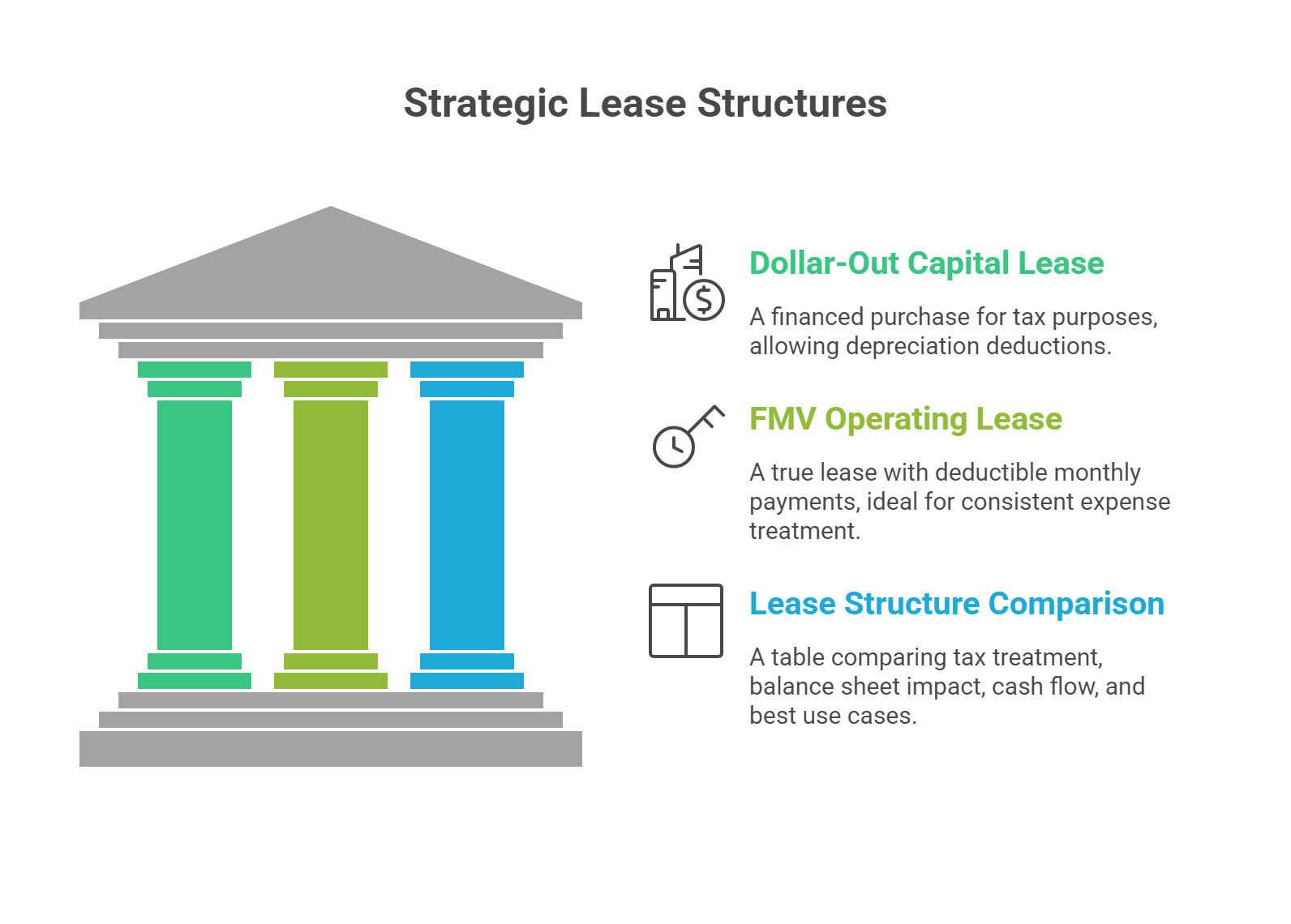
Dollar-Out Capital Lease
A dollar-out capital lease is a financed purchase for tax purposes. The lessee records the equipment as an owned asset and may claim depreciation deductions over its useful life. In the year the equipment is placed in service, this structure may allow the lessee to claim Section 179 expensing or bonus depreciation on the full equipment cost.
For CFOs with taxable income to offset in the current year, this structure can significantly reduce effective tax liability. A $2 million equipment acquisition under a dollar-out capital lease could reduce taxable income substantially in year one.
FMV Operating Lease
An FMV (fair market value) operating lease is structured as a true lease. Monthly payments are typically deductible as operating expenses, providing a predictable, recurring deduction spread across the lease term. This works well for companies that want consistent expense treatment or that cannot use large first-year depreciation deductions.
Companies with variable income cycles often prefer this structure because the deduction is available every month, regardless of profit spikes.
Lease Structure Comparison
| FMV Operating Lease | Dollar-Out Capital Lease | Equipment Loan | |
|---|---|---|---|
| Tax Treatment | Payments typically deductible as operating expenses | Depreciation deductions available; Section 179 eligible | Interest deductible; depreciation taken on owned asset |
| Balance Sheet Impact | Off-balance-sheet in many cases | Asset recorded on balance sheet | Asset and liability both recorded |
| Cash Flow Impact | Lower monthly payments; residual payment at end of term | Slightly higher payments; ownership transfers at end of term | Fixed payments; full ownership from day one |
| Best Use Case | Lower near-term payments with an end-of-term purchase option; predictable recurring deduction | Long-term ownership; high taxable income to offset | Outright ownership through conventional financing |
Not sure which structure fits your situation? Request a Quote and we will walk through the options with your team.
Section 179 and Bonus Depreciation
Section 179 allows businesses to deduct the full purchase price of qualifying equipment in the year it is placed in service. For 2026, that deduction cap is $2,560,000, with a phase-out beginning at $4,090,000 in total equipment purchases. You can finance a major acquisition and potentially take the full deduction that year without deploying the full cash amount.
Bonus depreciation is now permanent at 100% under the One Big Beautiful Bill Act. Unlike Section 179, it has no income cap and can create or increase a net operating loss to carry forward. Both provisions interact directly with the dollar-out capital lease structure.
Buddy Zarbock, Founder & CEO of Commercial Funding Partners, has advocated for these provisions in Washington, D.C. through the ELFA Political Action Committee. He has chaired the AACFB Education Committee for four years and serves on ELFA’s Board of Independent Lessors.
Consult your CPA to confirm how these figures apply to your 2026 filings.
Equipment-Only Liens: Protecting Balance Sheet Flexibility
Bank equipment financing often comes with blanket liens that encumber receivables, inventory, and other company assets. That blanket coverage reduces your flexibility and can trigger covenant reviews. We structure equipment financing using only the financed equipment as collateral.
Your receivables, working capital, and other assets remain unencumbered. This matters when you are managing covenant ratios across multiple credit facilities. You can fund the equipment acquisition without triggering a review of your primary credit facility, keeping the bank relationship intact.
Bank-Complementary Financing: Growing Without Disrupting Existing Relationships
We work alongside your existing bank relationship, not around it. Financing equipment separately keeps your primary credit lines available and does not require your bank to approve the transaction. We operate as a direct lender with a lean credit committee, and decisions can happen the same day when the deal is prepared.
Buddy explains that we help customers with restrictive bank covenants and exposure limits in a competitive way. Our pricing is competitive with banks, and we can fund much faster. This strategy preserves the banking relationship while extending your financing capacity.
We also handle international vendor deposits, including payments in euros for equipment sourced from Germany or Switzerland. If your equipment is being manufactured overseas, we can fund the deposit and progress payments.
To learn about our direct lender model, visit our About Us page.
What This Looks Like in Practice
A masonry company with $9 million in owned equipment needed liquidity for a strategic acquisition. We structured a sale-leaseback that unlocked $8 million in working capital. The company retained full use of all productive equipment and funded the acquisition without a bank transaction.
A manufacturer with a revenue disruption was unbankable by conventional standards. Traci and the credit committee structured a $9 million equipment upgrade using the equipment itself as collateral. The company modernized its production lines, won new contracts, and returned to a bankable credit profile within two years.
A company that rented expensive equipment converted to a five-year lease, freeing up $50,000 per month in cash flow. The lease payment was lower than the rental rate, and the equipment was now producing in accordance with the company’s production schedule.
The Role of the Expert Team
Traci Dolphin, President, Equipment Leases, Inc., leads credit policy and deal structuring for every transaction. Her experience spans mortgage lending, commercial credit, and equipment leasing. She looks at the total story and builds structures that clients can execute.
Buddy Zarbock, Founder & CEO, Commercial Funding Partners, brings over 20 years of experience and deep involvement in industry policy. He holds an MBA from Westminster College and a BS from the University of Utah. He has received the AACFB President’s Award and has served on ELFA’s Political Action Committee.
Hardware and tax decisions are inseparable for a CFO. Equipment Leases, Inc. is a financing partner, not a tax advisor. We bring the structure, and your CPA confirms the tax outcome. Let’s discuss your next project.
Ready to Structure Your Next Acquisition?
If you are managing a significant equipment acquisition while protecting cash, the structure you choose determines how well you reach your goals. Rate matters, but structure matters more. We work with finance leaders across manufacturing, medical, energy, and construction.
Our credit committee moves fast when you come prepared. We build financing programs designed to improve with every transaction.
To get started, Request a Quote or Contact Us.
Frequently Asked Questions
Can I claim Section 179 deductions on leased equipment?
Eligibility depends on the lease structure. Dollar-out capital leases are generally treated as financed purchases for tax purposes and may qualify for Section 179 expensing or bonus depreciation. Consult your CPA or tax advisor before finalizing any structure. Tax outcomes vary by company situation and applicable IRS limits.
How does equipment financing affect my bank covenants?
Equipment-only collateral structures keep financing out of your primary bank credit facility. This means most bank covenants are not triggered. Review your specific covenant language with your legal or financial team before proceeding.
What is the difference between an FMV lease and a dollar-out lease?
An FMV lease lets you return or purchase the equipment at market value at the end of the term. A dollar-out lease transfers ownership for one dollar at the end. For a deeper breakdown, see our tax benefits guide.
Does progress funding delay equipment delivery?
No. Progress funding disburses payments to vendors according to the build or delivery schedule. The equipment timeline is not affected. It simply means you are not fronting the cash between milestones.
When should a CFO pay cash instead of financing equipment?
Paying cash makes sense for very small acquisitions where financing costs outweigh the liquidity benefit. For most acquisitions over $250,000, the cash preservation and tax benefits of financing outweigh the interest cost.
What financing amounts do you work with?
We fund transactions from $250,000 up to $100 million or more per project. This applies to all major equipment categories and industries nationwide.
