
Equipment Financing for Venture Capital Firms
Non-Dilutive CAPEX to Extend Runway and Preserve Ownership
Transform CAPEX into a growth accelerator, not a dilution event. Our non-dilutive leasing structures enable your portfolio companies to acquire essential equipment while preserving equity and extending their cash runway.
For venture capital firms, Equipment Leases serves as the equipment leasing arm that transforms CAPEX into a growth accelerator—not a dilution event.
Our non-dilutive leasing structures enable portfolio companies to acquire essential equipment while preserving equity and extending their runways.
From medical technology and diagnostics to advanced manufacturing and clean tech, Equipment Leases enables venture-backed companies to scale faster without sacrificing ownership or increasing burn.
VC firms rely on Equipment Leases to complement equity capital through structured equipment leasing, strengthening balance sheets and accelerating commercialization.
Why Venture-Backed Companies Choose Equipment Leases
Non-Dilutive Capital Structure
Our standard equipment leasing structures carry no equity component—no warrant coverage, no equity kickers, no ownership transfer. For a company at a $20M valuation financing $2M in equipment, that can mean preserving 10% of ownership that compounds dramatically at exit. We finance the equipment. You keep the company.
Equipment Value-Based Underwriting
We evaluate the equipment itself—its value, useful life, and revenue-generating capacity. This approach opens financing to pre-revenue companies, early-stage startups, and businesses that don’t meet traditional bank criteria. What matters to us is whether the equipment will help your business grow—not how long you’ve been operating.
Faster Than Traditional Lenders
Growth-stage companies don’t have 8–12 weeks to wait for bank approvals. Our typical timeline runs 4–6 weeks from initial contact to funded equipment. For time-sensitive situations, we can compress that further. Speed matters when customer commitments are on the line, equipment delivery windows are fixed, or your product roadmap depends on deploying assets.
Deep Sector Expertise
We’ve structured equipment financing for companies in medical technology, diagnostics, cleantech, advanced manufacturing, biotech, and food processing. We understand the specific equipment you’re acquiring, the revenue model it supports, and the commercialization timeline you’re operating against. That expertise translates directly into better structures and faster execution.
Runway Extension and Balance Sheet Strength
Equipment financing preserves your cash position and extends the time between equity raises. For many of our clients, a well-structured leasing arrangement adds 6–18 months of runway—enough to hit the milestones that drive meaningful valuation improvement at the next round. Investors see capital-efficient CAPEX as a sign of operational discipline, not a liability.
Flexible Structures for Growth Companies
We offer operating leases, capital leases, and equipment loans—with payment flexibility including monthly, quarterly, seasonal, and deferred options. Deferred payment structures are available for pre-revenue companies with defined ramp timelines. Minimal financial covenants are the standard, not the exception, for growth-stage companies. And as your business scales, we can structure upgrades, expansions, and multi-site deployments under a master lease framework.
A Partner in Your Portfolio, Not a Vendor
Venture capital firms introduce Equipment Leases to portfolio companies because we act as a financing partner—not a transactional lender. We move at the speed your business requires, structure deals that complement your equity capital, and remain engaged through the full lifecycle of the lease. We finance the equipment that powers your growth.
The Growing Need for Non-Dilutive Capital in Venture
As venture capital deployment has grown to $425 billion annually, portfolio companies face increasing pressure to deploy capital efficiently. Equipment financing has emerged as a critical tool for extending runway and preserving equity value.
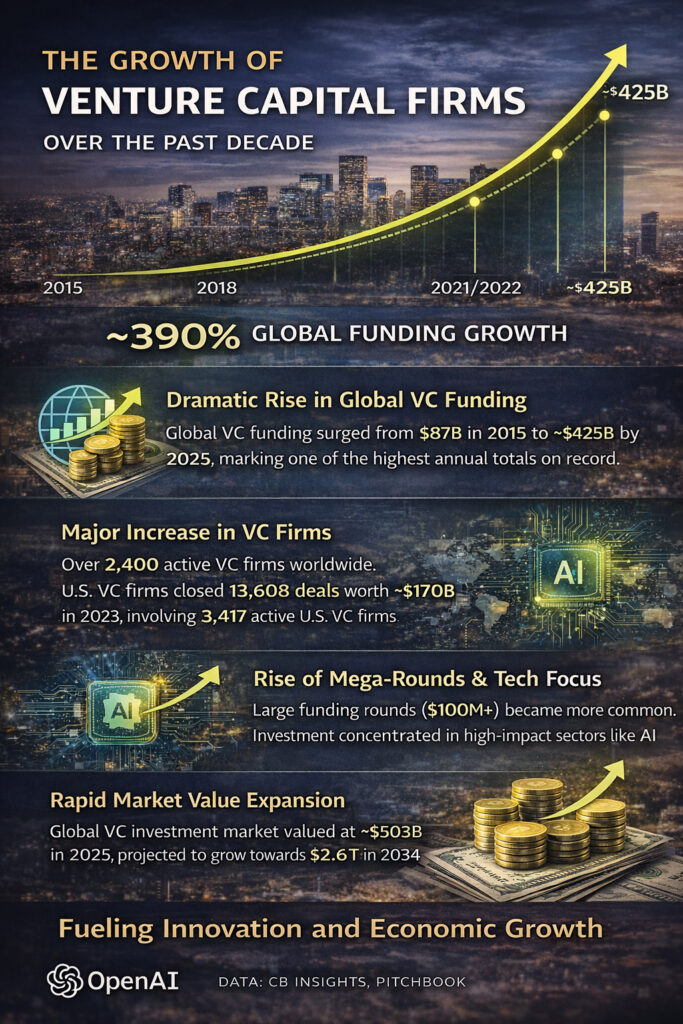
Over the past decade, venture capital firms and the VC industry have grown significantly in terms of investment value, activity, and global presence, though with ups and downs tied to market conditions and sector trends:
Growth in Venture Capital Investment
- Global venture capital funding surged in recent years, reaching around $425 billion in 2025—a roughly 30% increase over 2024 and one of the highest annual totals on record, trailing only the peaks of 2021 and 2022. This capital growth has created unprecedented demand for complementary non-dilutive financing solutions.
- In the first half of 2025, VC investment value rose about 25% globally compared to the first half of 2024, highlighting continued momentum in deal value.
Ecosystem Expansion
- The number of active VC firms globally is substantial, with reports indicating over 2,400 as of 2025. Each firm manages 10–50 portfolio companies with equipment needs ranging from $250K to $25M+.
- In the U.S. specifically, there were 3,417 active VC firms by the end of 2023, which closed 13,608 deals worth approximately $170.6 billion—showing the scale and depth of VC activity.
Fundraising and Shift in Capital Deployment
- While venture fundraising has faced market headwinds—such as slower fundraising in 2024 with about $76 billion raised, the lowest since 2019—capital remains significant and large funds continue to operate. Slower fundraising makes non-dilutive equipment financing even more critical for portfolio companies managing their runway.
- Mega-rounds (very large funding rounds, often $100 million+) have become more common, especially in sectors like AI, further concentrating capital flows among fewer, high-impact deals.
Market Value and Future Growth
- The global VC investment market was valued at roughly $503 billion in 2025, with forecasts projecting strong growth toward over $2.6 trillion by 2034—reflecting long-term expansion and institutional interest.
What This Means for Portfolio Companies
For portfolio companies, this VC growth creates both opportunity and pressure:
- More competition for equity capital—making non-dilutive alternatives increasingly attractive.
- Pressure to extend the runway between rounds and demonstrate capital efficiency.
- Focus on unit economics and operational discipline ahead of each new raise.
- Need for flexible CAPEX solutions that don’t dilute ownership or complicate cap tables.
Startup Equipment Financing Success Stories
Case Study: MedTech Startup Extends Runway 9 Months
Investor Profile
Investor Type: Venture Capital Firm (Series B)
Sector: Medical Technology & Diagnostics
Investment Objective: Accelerate commercialization while minimizing dilution
The Challenge
A venture-backed medical diagnostics company required advanced laboratory and imaging equipment to move from pilot testing to full commercial deployment. The next equity round was planned for 12–18 months out, and the VC firm wanted to avoid unnecessary dilution while preserving valuation momentum.
The founding team faced a difficult choice: raise dilutive bridge financing for equipment, or delay commercialization and risk missing their market timing window.
Traditional bank financing was not an option due to limited operating history, and raising additional equity too early would have diluted founders and investors.
The Equipment Leases Solution
The VC firm partnered with Equipment Leases as its portfolio company’s equipment leasing and CAPEX execution arm. Equipment Leases structured $2.8 million in non-dilutive equipment leases tied directly to revenue-generating assets.
The solution included:
- Fast approvals aligned with product rollout timelines
- Non-dilutive leasing structures
- Flexible payment schedules matched to customer ramp-up
- Financing based on equipment value—not venture credit

The Results
- $2.8M in growth-critical equipment deployed without dilution
- Runway extended by 9+ months
- Accelerated path to commercialization
- Improved valuation ahead of Series C raise
- By avoiding a bridge round at pre-commercial valuation, founders and early investors preserved an estimated 12–15% of ownership
Equipment Leases enabled the portfolio company to scale operations without sacrificing ownership, turning CAPEX into a strategic growth lever rather than a dilution event.
Case Study: Cleantech Manufacturer Scales 60% Without Dilution
Investor Profile
Investor Type: Venture Capital Firm (Growth Stage)
Sector: Clean Energy & Advanced Manufacturing
Investment Objective: Rapid capacity expansion to meet demand
The Challenge
A Cleantech portfolio company experienced rapid customer adoption but lacked the manufacturing equipment required to meet demand at scale. Equity capital was prioritized for R&D and market expansion, not fixed assets.
Customer commitments required equipment delivery within 4 months—faster than any equity raise timeline could support.
The VC firm needed a capital-efficient way to fund production equipment without increasing burn or forcing an early equity round.

The Equipment Leases Solution
Equipment Leases stepped in as the portfolio company’s outsourced CAPEX and equipment leasing partner, structuring $5.1 million in equipment leases for automated production systems and testing equipment. The financing was structured as operating leases with purchase options, providing balance sheet flexibility.
The financing was structured to:
- Preserve equity capital
- Align payments with production milestones
- Support rapid deployment across multiple facilities
- Avoid restrictive financial covenants
The Results
- $5.1M in production equipment financed non-dilutive
- Manufacturing capacity increased by over 60%
- Improved unit economics through automation
- Equity capital preserved for strategic growth initiatives
- The $5.1M equipment financing preserved an estimated $25M+ in exit value for founders and investors
By using Equipment Leases as a CAPEX partner, the VC firm enabled rapid scale while maintaining ownership discipline and capital efficiency.
The Case for Non-Dilutive Equipment Financing
Every dollar of equity capital deployed on equipment is a dollar that can’t go toward hiring, market expansion, or R&D. More importantly, it’s equity you can never get back. Understanding the real cost of equipment purchases—and when leasing makes financial sense—is one of the most valuable conversations we have with founders and investors.
The Real Cost of Equipment from Equity Capital
When you fund equipment purchases with equity capital, you pay far more than the sticker price. Consider this:
- A $2M equipment purchase funded at a $20M pre-money valuation costs you 10% of your company.
- If you reach a $100M exit, that same $2M in equipment actually cost you $10M in exit value.
- Equipment Leases structures the same $2M in equipment for structured monthly payments—preserving that $8M in exit value for founders and investors.
Non-dilutive equipment financing lets you acquire the assets you need without transferring ownership. For venture-backed companies managing equity carefully, this distinction compounds dramatically over time.
When Equipment Financing Makes Sense
Equipment leasing is a strong strategic choice when:
- You’re between funding rounds and need to extend your runway by 6–18 months without raising additional equity.
- Your next raise is 12–18 months out, but your equipment needs are immediate.
- You want to preserve equity capital for hiring, market expansion, or R&D—not fixed assets.
- The equipment you need has clear, direct revenue-generating capacity.
- You need to hit key operational milestones before your next valuation event.
When Equity Capital Is the Better Choice
We believe in being straightforward—equipment financing isn’t always the right answer. Equity capital makes more sense when:
- The equipment is experimental or unproven technology with uncertain ROI.
- Your burn rate is unsustainable regardless of how you approach CAPEX.
- You’re pre-revenue with no clear near-term path to commercial traction.
- The equipment doesn’t directly enable revenue generation or operational milestones.
We’d rather give you an honest assessment than structure a deal that doesn’t serve your growth. That’s what it means to act as a true financing partner—not just a vendor.
CAPEX Solutions for Every Stage of Growth
Equipment needs evolve as your company scales. Equipment Leases structures financing at every stage of the venture lifecycle—from post-seed lab buildouts to institutional-grade capacity expansions ahead of an IPO or strategic exit.
-
Seed Stage / Pre-Revenue: Typical equipment needs include lab equipment, prototyping tools, and initial manufacturing setups. Financing is based on equipment value and its revenue-generating purpose—not company credit history. Typical deal sizes: $250K–$1M.
A biotech startup can finance $500K in laboratory equipment post-seed, preserving equity capital for 12+ months of R&D runway.
- Series A / Early Revenue: As you move toward commercialization, equipment needs expand to include commercial-grade manufacturing systems, expanded lab capacity, and customer fulfillment infrastructure. Revenue projections support faster approvals, and deal structures can be aligned to ramp-up timelines. Typical deal sizes: $500K–$3M. This is where equipment financing delivers some of its strongest ROI—enabling commercial scaling without diluting Series A terms or pulling forward a follow-on raise.
- Series B / Scaling Phase: Series B companies are expanding production, deploying across multiple sites, and investing in automation. Company credit is strengthening, larger financing facilities become available, and payment structures can be aligned with production milestones. Typical deal sizes: $2M–$10M.
- Series C+ / Growth Stage: At this level, equipment needs are institutional in scale—major capacity additions, geographic expansion equipment, and operational efficiency investments. Multiple equipment types can be financed under a master lease framework. For companies preparing for an IPO or strategic exit, equipment financing also supports balance sheet optimization. Typical deal sizes: $5M–$100M+.
- Bridge Financing / Between Rounds: Some of the most time-sensitive situations we encounter involve mission-critical equipment that can't wait for the next equity close. Fast approval and flexible structures are essential. By separating CAPEX from your equity timeline, we help you hit operational milestones, avoid down-round risk, and walk into your next raise from a stronger position. Typical deal sizes: $500K–$5M.
Equipment Financing for High-Growth Sectors
We bring deep sector expertise to every deal. Understanding the specific equipment, approval timelines, and commercialization cycles of your industry allows us to structure financing that fits your business—not a generic template.
Medical Technology & Diagnostics
We finance laboratory equipment, imaging systems, diagnostic tools, and clinical trial equipment. MedTech companies face long FDA approval timelines and high upfront costs—often before a dollar of commercial revenue is recognized. Our non-dilutive structures allow you to build out your infrastructure during the approval process, so you’re ready to ship the moment clearance arrives. Typical deal sizes: $1M–$10M.
Cleantech & Renewable Energy
Clean energy and advanced manufacturing companies face capital-intensive commercialization cycles. Equipment Leases finances production lines, testing systems, pilot facility equipment, and manufacturing systems—structured to preserve equity capital during scale-up and align payments with production milestones.
Advanced Manufacturing & Hardware
From CNC machines and 3D printers to automated assembly lines and quality testing systems, we understand the high upfront costs and rapid technology evolution that define hardware companies. Our flexible structures include upgrade and trade-up options as your manufacturing technology improves.
Biotech & Life Sciences
We finance research equipment, clinical lab systems, bioreactors, and specialized storage for biotech and life sciences companies. Long development cycles and uncertain clinical timelines make runway extension through non-dilutive CAPEX especially strategic in this sector.
Industrial Technology & Robotics
Robotics systems, automation equipment, and industrial IoT infrastructure are core competencies. We work with companies deploying these systems in manufacturing, logistics, and healthcare settings—structuring financing to align with the revenue impact of automation investments.
Food & Beverage Production
Commercial kitchen systems, packaging equipment, and quality control infrastructure are common financing needs for emerging food and beverage companies. We structure deals that align with seasonal revenue cycles and production ramp-up timelines.
The Equipment Financing Process for Venture-Backed Companies
We’ve designed our process specifically for the pace and demands of venture-backed companies. From initial contact to funded equipment, here’s what to expect.
Initial Consultation (24–48 Hours)
We start with a quick review of your equipment list, basic company information, funding stage, and revenue projections. Our underwriting focuses on equipment value and its revenue-generating capacity—not your company’s credit score or operating history. You’ll receive an initial indication of terms before the week is out.
Equipment Assessment (48–72 Hours)
We evaluate the equipment itself—its value, useful life, and revenue model. If a VC sponsor is involved, we coordinate directly with your investment team. You’ll receive a preliminary term sheet within 5–7 business days of submission.
Documentation & Structuring (1–2 Weeks)
The required documents are straightforward: equipment quotes, a business plan or pitch deck, financial projections, and a cap table. We offer operating leases, capital leases, and equipment loans—with payment flexibility including monthly, quarterly, seasonal, or deferred structures. Financial covenants are designed to be minimal for growth-stage companies.
Approval & Closing (1–2 Weeks)
Final credit approval, legal documentation, and equipment verification happen in parallel to minimize turnaround time. From first call to funded equipment, expect 4–6 weeks on a standard transaction. Expedited review is available for time-sensitive situations.
Equipment Deployment & Ongoing Partnership
We pay vendors directly, coordinate equipment delivery, and stay engaged throughout the lease term. As your company grows, we’re ready to structure expansion financing, equipment upgrades, and multi-site deployments under a master lease framework.
How This Differs from Traditional Bank Financing
Traditional banks focus on company credit history, cash flow, and collateral beyond the equipment. We focus on the equipment itself—its value and revenue-generating capacity. Banks typically require two or more years of operating history and profitability. We work with pre-revenue companies when the equipment use case and path to commercialization are clear. Where bank financing takes 8–12 weeks, our typical timeline is 4–6 weeks.
For Venture Capital Partners: Introducing Equipment Leases to Your Portfolio
Leading venture capital firms introduce Equipment Leases to portfolio companies as a capital-efficient tool for CAPEX deployment. By separating equipment financing from equity capital, you help your portfolio companies:
- Extend runway by 6–18 months between rounds
- Preserve equity for strategic initiatives—hiring, marketing, partnerships
- Improve capital efficiency metrics
- Maintain valuation momentum between raises
- Demonstrate operational discipline to future investors
How We Work with VC Partners
We operate with full confidentiality—under NDA when requested. VC partners can initiate conversations on behalf of a portfolio company, and we respond within 24–48 hours with an initial assessment. Our structures complement your cap table without adding complexity or conflicting with preferred stock terms. For firms managing multiple portfolio companies, we offer portfolio-level relationship options and consolidated reporting.
Common Questions from VC Partners
- Do you take warrant coverage or equity kickers? Our standard structures are non-dilutive. We do not require warrant coverage or equity participation as a condition of financing.
- How does this interact with preferred stock terms? Equipment leases are structured as asset-backed obligations and do not affect cap table dynamics, liquidation preferences, or protective provisions.
- Can you work across multiple portfolio companies? Yes. We actively partner with VC firms at the portfolio level and can structure consistent terms across multiple companies.
- What if the company is pre-revenue? We can finance pre-revenue companies when the equipment has a clear revenue-generating purpose, and the business model shows a credible path to commercialization.
- Do you require VC guarantees? No. We do not require VC firm guarantees as a condition of financing portfolio company equipment.
Common Questions About Startup Equipment Financing
How is equipment financing different from venture debt?
Venture debt is typically working capital secured by company assets and often includes warrant coverage. Equipment financing is asset-specific, based on the equipment’s value, and—in our standard structures—carries no equity component. It also doesn’t count against your enterprise leverage in the way venture debt does.
What if we're pre-revenue?
We can finance equipment for pre-revenue companies when the equipment has a clear revenue-generating purpose, the business model shows a credible path to commercialization, VC backing validates business potential, and the equipment itself has meaningful resale value. We evaluate each situation on its own merits.
Do you require personal guarantees from founders?
For most VC-backed companies, personal guarantee requirements are minimal or limited. For seed-stage companies without institutional backing, limited guarantees may apply depending on the deal structure. We’re transparent about this upfront.
How quickly can you approve and fund?
Our standard timeline is 4–6 weeks from initial contact to equipment delivery. For straightforward transactions, we can complete preliminary assessments within 72 hours. Contact us directly if your situation is time-sensitive—we build our process around the speed that growth-stage companies require.
What equipment types can you finance?
We finance manufacturing equipment, laboratory and diagnostic systems, medical devices, cleantech and renewable energy systems, commercial kitchen and packaging equipment, robotics and automation systems, and specialized tech infrastructure. We focus on revenue-generating equipment with tangible value.
What are typical payment terms?
Terms typically range from 24–60 months. We offer monthly, quarterly, or seasonal payment schedules, and deferred payment options are available for pre-revenue companies with defined ramp-up timelines. Purchase options at the end of the term are standard.
How does equipment financing affect our balance sheet?
Operating leases typically appear as off-balance-sheet obligations, thereby improving debt-to-equity ratios. Capital leases are recognized as assets and liabilities. The right structure depends on your accounting preferences and investor reporting requirements—we work with your team to determine what makes most sense.
What happens if we get acquired or go public?
Equipment leases transfer with the company in an acquisition or can be paid off at transaction close. For IPO situations, we offer pre-exit payoff options with no penalties for positive exit events. We build flexibility into our structures from day one.
What documentation do you need to get started?
To begin the review process, we typically need: equipment quotes or vendor invoices, a business plan or pitch deck, financial projections, cap table, and a VC term sheet if applicable. We keep the documentation process as streamlined as possible—our goal is to move fast, not create paperwork.
Get Started with Equipment Financing
For Startup Founders: Finance Your Equipment Without Dilution
Submit your equipment list for a no-obligation assessment. We typically respond within 24–48 hours with a preliminary indication of terms.
- Submit your equipment list and basic company information.
- Review preliminary terms within 5–7 business days.
- Fund your equipment in 4–6 weeks.
No equity. No dilution. Just the equipment your company needs to grow.
For VC Partners: Introduce Equipment Leases to Your Portfolio
We make it simple to introduce Equipment Leases to your portfolio companies. Your firm can initiate the conversation directly—we’ll take it from there, working confidentially and quickly to assess whether a deal makes sense. We offer portfolio-level relationships with consistent terms, fast response times, and consolidated reporting options.
Contact our Funding Specialist