

Equipment Financing for Real Estate Private Equity
Asset-Backed CAPEX for Yield and Risk Management
Optimize your capital stack and drive higher IRRs by separating equipment assets from real estate financing. We partner with Real Estate Private Equity firms to execute strategic equipment carve-outs, reducing equity requirements and unlocking capital efficiency for healthcare, industrial, and logistics developments.
Real estate private equity firms use Equipment Leases as a CAPEX partner to finance equipment independently from real property.
This strategy unlocks capital efficiency, reduces equity requirements, and improves project-level returns.
Equipment-heavy assets such as healthcare facilities, logistics hubs, and industrial developments benefit from separating equipment risk from real estate risk. Equipment Leases structures leases that integrate cleanly into complex capital stacks.
Real Estate Private Equity has Grown Over the Past Decade
The growth in real estate private equity has created increased demand for sophisticated capital stack optimization strategies. As institutional capital flows into healthcare, industrial, and logistics real estate, sponsors face pressure to maximize returns while minimizing equity requirements. Equipment financing has emerged as a critical tool for achieving both objectives.
Growth in Capital and Investment Activity
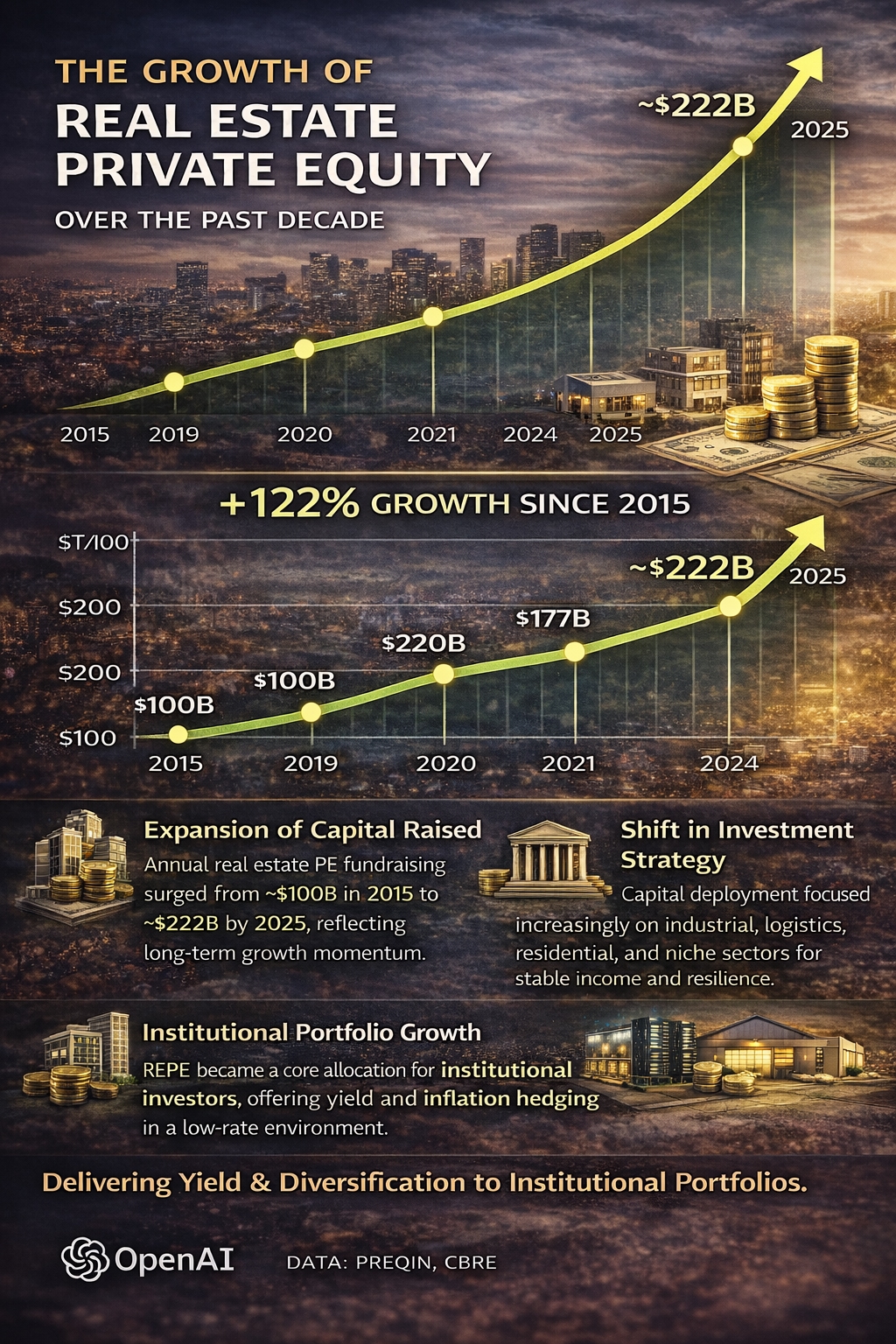
- The private real estate sector has seen significant capital inflows and expansion since 2015 as institutional investors increase allocations to real assets for income and diversification. While total dedicated real estate fundraising dipped in 2024 to its lowest since 2012, it began rebounding in 2025 with increased activity and capital raised by major firms like Blackstone and Brookfield.
Capital Deployment and Strategy Shifts
- Capital allocation in real estate private equity has evolved, with investors increasingly focusing on industrial, logistics, residential, and niche sectors that deliver stable income and resilience against market volatility. These shifts demonstrate how the industry has adjusted to changing interest rate environments and investor preferences.
Fundraising and AUM Trends
- Institutional real estate private equity fundraising rebounded in 2025 with roughly $222.2 billion raised, up about 29% from 2024.
- The overall global private real assets ecosystem, including real estate continues to attract long-term capital as part of broader private markets growth; real estate often represents a defensively oriented allocation within large portfolios.
- This capital expansion means more projects requiring equipment-heavy tenant improvements. Healthcare real estate alone represents $X billion in annual medical equipment installations, while logistics facilities require $X billion in automation and material handling systems.
Summary: Broad Trends Over the Past Decade
- Over the last 10 years, real estate private equity has expanded as a core part of institutional portfolios searching for yield and long-term income amid low-yield public markets.
- Despite cyclical dips (e.g., in 2024), capital flows rebounded as investors evaluated real estate’s risk-adjusted returns and strategic diversification benefits.
- Real estate equity fundraising and deployment have remained dynamic, particularly in sectors like industrial and residential, underlying the asset class’s resilience and growth trajectory.
For Real Estate Sponsors, These Trends Mean:
- More competition for deals, requiring capital efficiency strategies
- Pressure to improve IRRs without increasing risk
- Focus on tenant stickiness and lease certainty
- Need for flexible CAPEX solutions that don’t overcapitalize assets
- Equipment carve-outs as competitive advantage in bid situations
Why Real Estate Sponsors Choose Equipment Leases
- Separate equipment from real property financing
- Optimize capital stacks and improve IRR
- Reduce equity requirements
- Support healthcare, industrial, and logistics assets
- Improve tenant onboarding and retention
- Transaction size: $500K to $100M+ per project
- Term sheet: 1–2 weeks from first conversation
- Approval timeline: 2–3 weeks for most transactions
- Collateral: Equipment only, no liens on real estate or other business assets
- Coverage: Nationwide
- Lease terms: 5–10 years, aligned with tenant lease
- Structures available: Operating lease, capital lease, equipment loan
The Equipment Carve-Out Process for Real Estate Projects
An equipment carve-out separates equipment costs from real estate financing, allowing each to be financed according to its unique characteristics. The real estate is financed through traditional property loans based on building value and projected NOI, while equipment is financed through asset-specific leases or loans based on equipment value and cash flow.
This separation provides multiple benefits such as:
- Reduced real estate loan size and corresponding debt service
- Lower equity contribution requirements
- Improved property loan-to-value ratios
- Better matching of financing terms to asset useful life
- Enhanced project-level IRR
Project Scoping and Equipment Identification (Development Stage)
During project planning:
- Identify equipment that’s distinct from real property
- Estimate equipment costs and tenant requirements
- Assess whether equipment is tenant-specific or property-specific
- Determine equipment useful life vs. real estate hold period
- Evaluate whether equipment should be owned by sponsor, tenant, or special entity
Equipment typically suitable for carve-out:
- Medical imaging and diagnostic equipment
- Commercial kitchen equipment
- Warehouse automation and material handling
- Refrigeration systems in cold storage
- Data center power and cooling infrastructure
- Manufacturing equipment in industrial facilities
Capital Stack Structuring
Once the equipment scope is identified, we model the financing structure alongside your real estate loan. The mechanics are straightforward and the impact is meaningful.
Traditional Approach | With Equipment Carve-Out | |
|---|---|---|
Total Project Cost | $20M | $20M |
Equipment Component | Rolled into RE loan | Financed separately |
Equity Required | $6M (30%) | $4.5M |
Equity Reduction | — | 25% less |
Project IRR | 15% | 16.5%+ |
Same deal. Better returns.
Coordination with Property Lender (Critical)
Equipment Leases works with the real estate lender to ensure:
- Equipment financing doesn’t violate loan covenants
- Lien positions are clear (equipment lender has first lien on equipment, property lender has first lien on real estate)
- Property lender receives comfort that equipment will be in place
- Payment structures align (if equipment payments flow through as rent)
- Intercreditor agreement if needed
Common structures:
- Equipment owned by the tenant (most common in healthcare)
- Equipment owned by the sponsor entity is separate from the property entity
- Equipment owned by the equipment lender, leased to the tenant
- Triple-net lease structure where the tenant pays both rent and equipment payments
Equipment Lease Structuring (Pre-Construction or During Construction)
Equipment Leases structures financing to match project needs:
For build-to-suit projects:
- Term sheet during construction
- Funding upon equipment delivery and installation
- Interest-only period during installation
- Full payments commence upon tenant occupancy
For acquisition and renovation:
- Quick approval to match the acquisition timeline
- Funding coordinated with the property close
- Equipment lease becomes part of the tenant’s obligations
Lease terms typically:
- 5-10 years matching tenant’s lease term
- Monthly payments aligned with tenant rent collection
- Purchase option or fair market value buyout at the end
- Tenant responsibility for maintenance (triple-net structure)
Closing and Integration (Construction Phase)
Equipment financing closes:
- Simultaneously with a property loan (new construction), or
- Shortly after property acquisition (repositioning), or
- Upon tenant commitment (build-to-suit)
Equipment Leases:
- Pays vendors directly for equipment
- Coordinates with the construction schedule
- Ensures equipment installation and tenant acceptance
- Perfects security interest in equipment (UCC-1 filings)
Tenant relationship:
- Tenant may sign the equipment lease directly, or
- Sponsor signs equipment lease, tenant pays as additional rent, or
- Equipment becomes part of the tenant improvement package
Ongoing Management and Exit Planning
During the hold period:
- Equipment lease payments are typically paid by the tenant
- Sponsor maintains property, tenant maintains equipment
- Equipment Leases manages payment processing
- Annual equipment verification (for large assets)
At exit:
- Equipment lease typically transfers to the buyer, or
- Equipment can be purchased out of lease, or
- If the tenant vacates, the equipment can be refinanced or sold
Because equipment was financed separately, the property can be sold based on real estate fundamentals without equipment complications. Alternatively, if equipment lease transfers to the buyer, it can enhance property attractiveness by ensuring tenant retention.
Real Estate Growth Journeys Backed by Equipment Financing
Case Study 1 - Real Estate Private Equity Firm Improves IRR by Carving Out Equipment CAPEX in Healthcare Development
Real Estate Investor Profile
Sponsor Type: Real Estate Private Equity Firm
Asset Type: Medical Office Building (MOB) + Diagnostic Center
Investment Strategy: Core-plus healthcare real estate
The Challenge
A real estate private equity sponsor was developing a multi-tenant medical office and diagnostic facility anchored by imaging and outpatient services. While the real estate underwriting was strong, the project required $6.8 million in imaging and diagnostic equipment to support tenant operations.
Including equipment costs within the real estate capital stack would have increased equity requirements and reduced projected IRR. The sponsor needed a way to separate equipment CAPEX from the real property financing while still supporting tenant readiness.
The Equipment Leases Solution
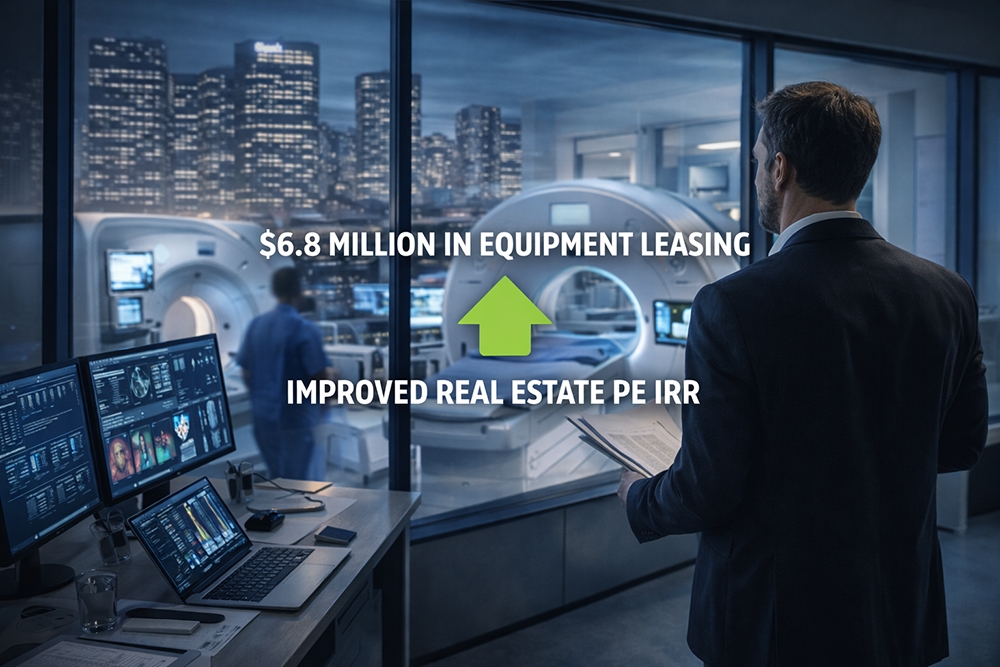
The sponsor partnered with Equipment Leases to carve out and finance the equipment independent of the real estate loan. Equipment Leases structured $6.8 million in equipment leasing for MRI, CT, and diagnostic systems used by the anchor tenants.
The solution allowed
- Equipment to be financed off the real estate balance sheet
- Lower equity contribution at the project level
- Faster tenant build-out and occupancy
- Alignment of equipment payments with tenant lease income
The Results
- Project IRR increased by over 150 basis points
- Reduced equity requirements at closing
- Tenants are operational on schedule
- Cleaner separation of real estate and operational risk
Real Estate PE Takeaway
By partnering with Equipment Leases, the sponsor optimized its capital stack while preserving long-term asset value.
Case Study 2 - Industrial Real Estate Sponsor Uses Equipment Leasing to Enhance Returns on Logistics Asset
Real Estate Investor Profile
Sponsor Type: Real Estate Private Equity Firm
Asset Type: Industrial / Logistics Facility
Investment Strategy: Value-add industrial development
The Challenge
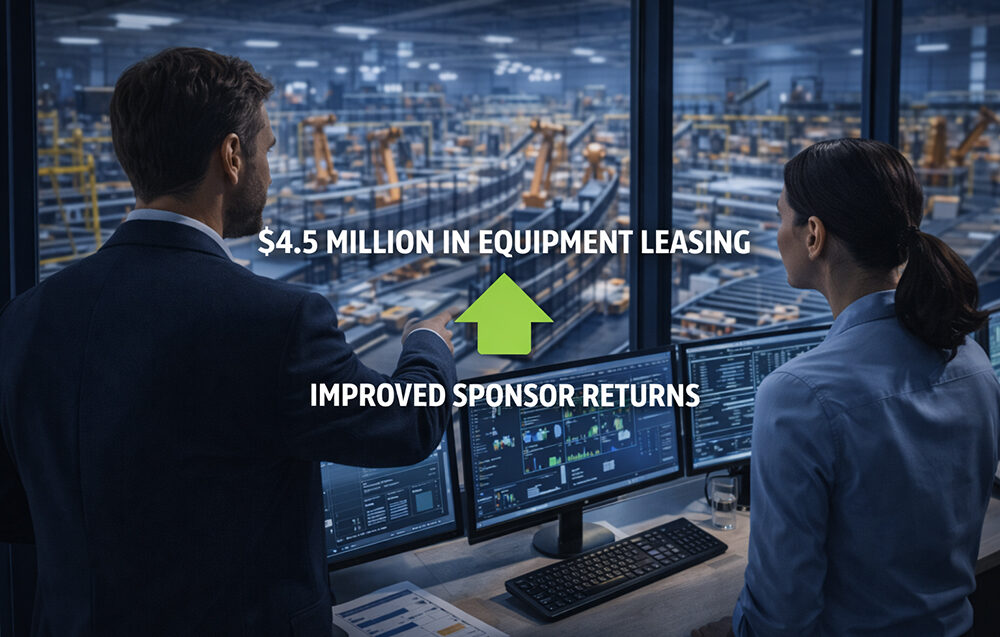
A real estate PE sponsor acquired and repositioned a logistics facility designed for advanced warehousing and automated distribution. The tenant required significant equipment investments, including conveyor systems, robotics, and automated sorting equipment, totaling $4.5 million.
Funding equipment through traditional tenant improvement allowances or additional equity would have reduced sponsor returns and increased capital exposure.
The Equipment Leases Solution
Equipment Leases structured $4.5 million in equipment leasing directly tied to the tenant’s operational systems. The financing was carved out of the real estate stack and aligned with the tenant’s lease terms.
This approach
- Preserved sponsor equity
- Reduced upfront tenant improvement costs
- Enabled faster lease execution
- Improved cash-on-cash returns
The Results
- Higher cash-on-cash returns in year one
- Reduced capital intensity at acquisition
- Increased tenant stickiness due to integrated infrastructure
- Improved exit optionality
Real Estate PE Takeaway
Equipment leasing allowed the sponsor to enhance returns while supporting tenant operations without overcapitalizing the asset.
Equipment Financing by Real Estate Asset Class
Different real estate asset classes carry different equipment profiles, useful lives, and risk characteristics. Structured correctly, equipment carve-outs allow sponsors to align financing with each asset’s actual performance, improving capital efficiency while preserving underwriting clarity.
Healthcare Real Estate Equipment Financing
Healthcare real estate is one of the most common and effective use cases for equipment carve-outs. In many projects, tenant-specific equipment represents a substantial portion of total capital investment but does not materially enhance the underlying building value.
Medical Office Buildings (MOB)
Equipment types typically carved out:
- Diagnostic imaging (MRI, CT, X-ray, ultrasound)
- Laboratory equipment and analyzers
- Medical practice management systems
- Specialized surgical equipment
- Telemedicine infrastructure
Typical transaction characteristics:
- Equipment value: $500K–$10M per project
- Lease term: Aligned with tenant lease (typically 5–10 years)
- Structure: Often triple-net, mirroring property lease structure
- IRR impact: 100–200 basis points typical (structure-dependent)
- Equity reduction: 15–30% of total project cost (scenario-specific)
Why equipment carve-outs work for MOBs
Medical office buildings require significant tenant-specific equipment that is expensive to capitalize but does not meaningfully increase core real estate valuation. By carving out equipment financing:
- Sponsors reduce upfront equity requirements
- Real estate leverage metrics improve
- Equipment payments can flow through as additional rent
- NOI is maintained while the capital structure becomes more efficient
This structure allows delivery of tenant-ready space without overburdening the property loan.
Key considerations:
- Equipment typically remains tenant-specific
- Depreciation schedules are faster than real estate
- Property lender coordination is required
- Equipment investment can enhance tenant stickiness and lease certainty
Ambulatory Surgery Centers (ASC)
Equipment types:
- Surgical instrumentation and operating room equipment
- Anesthesia systems
- Sterilization and infection-control equipment
- Recovery room systems
- Specialized HVAC and environmental systems
Typical characteristics:
- Equipment value: $1M–$5M per center
- Often operator-owned while the facility is leased
- Equipment is mission-critical with a high replacement cost
- Strong procedure-based cash flow supports lease payments
In ASC environments, equipment is central to revenue generation. Separating equipment financing from real estate underwriting preserves liquidity for operators while allowing real estate underwriting to remain focused on lease coverage and property fundamentals.
Diagnostic Centers / Imaging Facilities
Equipment types:
- MRI systems ($1M+)
- CT scanners ($500K+)
- PACS systems
- Nuclear medicine equipment
- Mammography systems
Why equipment financing is critical
Diagnostic centers are fundamentally equipment-driven operations housed within real estate. Equipment typically accounts for 60–80% of total project cost but depreciates over 5–7 years, while the building maintains long-term value.
Separating equipment from property financing:
- Reflects distinct risk profiles
- Aligns the term with the useful life
- Prevents overleveraging the real estate component
- Preserves appropriate underwriting clarity for both asset types
Senior Living / Skilled Nursing
Equipment types:
- Commercial kitchen systems
- Laundry equipment
- Healthcare beds and monitoring systems
- Therapy and rehabilitation equipment
- Emergency backup systems
Considerations:
- Equipment maintenance tied to regulatory compliance
- Equipment critical to licensing and certification
- Often owner-operated, making equipment financing attractive
- Can improve debt service coverage by lowering the property loan size
In regulated healthcare environments, separating equipment often simplifies both compliance oversight and capital planning.
Industrial and Logistics Real Estate Equipment Financing
Modern industrial properties increasingly include high-value operational systems. In many cases, automation equipment rivals or exceeds the value of core building improvements.
Warehouse and Distribution Centers
Equipment types carved out:
- Conveyor and sortation systems
- Automated storage and retrieval systems (AS/RS)
- Warehouse management hardware
- Material handling equipment
- Dock systems
- Substantial racking installations
Typical transaction characteristics:
- Equipment value: $2M–$25M+
- Frequently built-to-suit with a single tenant
- Equipment tailored to tenant operations
- Lease term: 10–15 years common
Why carve-outs benefit industrial sponsors
Modern logistics facilities are technology-driven. Automation systems can exceed $10M in a single site. These assets are critical to tenant operations but may have limited redeployment value if vacated.
Separating equipment financing:
- Maintains lower real estate LTV
- Keeps equipment leverage outside property metrics
- Reduces sponsor equity in the project
- Improves cash-on-cash returns
- Preserves exit valuation based on real estate fundamentals
Manufacturing Facilities
Equipment types:
- Production machinery
- Specialized utilities and process HVAC
- Cranes and material handling systems
- Testing and quality control equipment
Considerations:
- Equipment is often highly specialized
- Environmental and regulatory factors may apply
- Useful life varies significantly
- May require tenant guarantees or additional security
Manufacturing carve-outs demand careful underwriting but can significantly improve capital efficiency when structured properly.
Cold Storage and Food Processing
Equipment types:
- Refrigeration systems (often $5M+)
- Blast freezers
- Food processing machinery
- Temperature-controlled racking
- Environmental control systems
Cold storage is an extreme example of equipment intensity. A 100,000 SF facility may include $15M in refrigeration infrastructure alone.
Financing refrigeration separately allows:
- Real estate lenders to underwrite the shell as industrial property
- Equipment financing to reflect 15–20 year replacement cycles
- Cleaner exit positioning
- Reduced real estate equity requirements
This separation simplifies underwriting and aligns financing with operational reality.
Flex / R&D Space
Equipment types:
- Laboratory systems
- Clean room infrastructure
- Specialized air handling
- Testing equipment
- Pilot manufacturing lines
These assets are typically tenant-specific with limited redeployment value. Equipment financing can support tenant attraction by reducing sponsor capital burden and accelerating project delivery.
Data Center and Technology Real Estate
Data centers blur the line between real estate and equipment more than any other asset class.
Data centers
Equipment types:
- Server and networking hardware
- Cooling systems and chillers
- Backup power (generators, UPS)
- Security and monitoring systems
- Raised flooring and cable management
This approach:
- Optimizes cost of capital
- Prevents misalignment between depreciation schedules and loan terms
- Enhances underwriting clarity
- Preserves flexibility for technology refresh cycles
In technology-driven real estate, capital stack precision becomes essential. Equipment carve-outs allow sponsors to treat infrastructure and IT investments as the operational assets they are, while preserving the integrity of real estate financing.
When structured correctly, equipment carve-outs are not just a financing tactic; they are a capital allocation strategy tailored to each asset class’s true performance.
This approach:
- Optimizes cost of capital
- Prevents misalignment between depreciation schedules and loan terms
- Enhances underwriting clarity
- Preserves flexibility for technology refresh cycles
In technology-driven real estate, capital stack precision becomes essential. Equipment carve-outs allow sponsors to treat infrastructure and IT investments as the operational assets they are, while preserving the integrity of real estate financing.
When structured correctly, equipment carve-outs are not just a financing tactic; they are a capital allocation strategy tailored to each asset class’s true performance.
Frequently Asked Questions from Real Estate Private Equity Sponsors
How does equipment financing affect my property loan?
Equipment financing is structured to complement, not complicate, your real estate debt. We take a first lien on the equipment only; the property lender retains a first lien on the real estate. When equipment payments flow through as tenant rent, they can actually strengthen debt service coverage. Most property lenders welcome the structure because it reduces their loan exposure while ensuring tenant improvements are fully funded.
What's the typical impact on project IRR?
IRR improvements depend on project specifics, but the mechanics are consistent. On a $20M project with a $5M equipment component, removing equipment from the equity stack reduces equity from $6M to $4.5M, a 25% reduction while total project cost and debt service stay identical. The impact is greatest when equipment accounts for more than 20% of project cost and the tenant’s lease term is long enough to support the financing structure.
What types of equipment qualify for carve-out financing?
Equipment needs to be identifiable and distinct from the real property, have independent value, and be essential to tenant operations. We commonly finance diagnostic imaging and medical systems, commercial kitchen equipment, warehouse automation, refrigeration systems, manufacturing equipment, and data center power infrastructure. Building structural systems, standard permanent HVAC, landscaping, and tenant furniture generally do not qualify.
Who owns the equipment — the sponsor, the tenant, or the lender?
The structure depends on your preferences and the nature of the tenant relationship. In a tenant-owned structure, the tenant signs the lease directly and takes responsibility for payments and maintenance, which is common in healthcare. In a sponsor-owned structure, you sign the lease, and equipment payments flow as additional rent, with the equipment transferring with the property at exit. An SPV structure is also available for complex capital stacks that require maximum flexibility. We structure around your tax, accounting, and exit strategy requirements.
What if my tenant vacates before the equipment lease ends?
We address this during structure design, not after. For build-to-suit projects with credit tenants, we align the equipment lease term with the property lease and rely on the tenant guarantee for security. For shorter-lease or multi-tenant situations, we underwrite based on equipment value rather than just tenant credit and focus on equipment types with strong secondary markets, including medical systems, commercial kitchen equipment, and industrial machinery.
How long does the approval and closing process take?
For new development, expect a term sheet within 1–2 weeks and committed financing in approximately 5–8 weeks from the first conversation. For acquisitions, we can close simultaneously with the property, with fast-track approval in 2–3 weeks. For equipment additions to existing properties, straightforward transactions are approved in 1–2 weeks. The key is early involvement; when we are part of initial project planning, we run in parallel with property financing rather than in sequence.
What are your typical terms and transaction sizes?
We finance equipment from $500K to $25M+ per transaction, with lease terms typically ranging from 5–10 years depending on equipment type and project structure. We offer operating leases, capital leases, and equipment loans, with monthly or quarterly payments aligned to your rent collection cycles. Pricing is competitive and structured to enhance overall project returns, not just optimize our rate.
Can you finance equipment for properties I already own?
Yes. Common scenarios include tenant rollover or expansion, property repositioning such as converting office space to medical use or modernizing industrial facilities, and portfolio optimization, where equipment is refinanced to reduce debt service or carved out of a property loan at refinance. Equipment financing on existing properties can improve cash flow and enable tenant improvements without requiring additional equity.
Do you work with all property lenders, or are there restrictions?
We have coordinated successfully with traditional banks, CMBS lenders, life insurance companies, debt funds, bridge lenders, and SBA 504 programs. Restrictions are rare, some CMBS loans carry additional debt covenants, and some construction loans require equipment to be part of the project loan, but we have navigated these situations before and can address lender concerns directly. The best practice is to introduce us to your property lender early.
What makes Equipment Leases different from other equipment finance companies?
We are a direct lender, meaning underwriting decisions are made in-house with our own capital, without a bank committee. Our senior credit committee moves quickly, and our financing capacity runs from $500K to $200M+ per project with the ability to syndicate larger transactions through our network of private equity partners, family offices, and banks. We understand complex capital stacks, coordinate directly with property lenders, and structure financing around tenant relationships. We finance the equipment and stay out of the way, and when you need us again, we are the first call.
Optimize Your Next Real Estate Project
If you’re developing or acquiring healthcare, industrial, logistics, or technology-driven real estate with meaningful equipment components, an equipment carve-out may improve capital efficiency and enhance project returns.
Let’s evaluate the structure before committing capital.
When to Contact Us
Engage early; equipment financing works best when integrated into the initial capital stack.
- Project planning stage — We help structure equity and leverage efficiently
- Acquisition due diligence — Fast approvals aligned with closing timelines
- Pre-development — Early coordination with property lender
- Tenant lease negotiations — Equipment can be structured within the TI package
Parallel execution with real estate financing prevents delays and avoids restructuring midstream.
What to Prepare
A preliminary discussion does not require finalized documents. For meaningful analysis, we typically request:
- Project overview and proforma
- Equipment list or estimated equipment budget
- Tenant information (if applicable)
- Property financing terms or lender details
- Target IRR and return thresholds
This allows us to evaluate the impact on equity, leverage, and hold-period returns.
Contact our Funding Specialist
(801) 461-3304
Confidentiality Assured: All project discussions are kept strictly confidential. We can execute NDAs before sharing sensitive project or tenant information.