
Equipment Financing for Private Equity Firms
Your Dedicated CAPEX Partner for Portfolio Growth
We partner with private equity firms to provide flexible private equity equipment financing for portfolio companies across acquisition, growth, and operational phases. Our capital solves CAPEX needs without diluting equity or constraining the credit facilities reserved for working capital and strategic initiatives, for transactions ranging from $250,000 to $200M+
Private equity firms partner with Equipment Leases as their dedicated equipment leasing and CAPEX execution arm. We enable sponsors to deploy capital strategically, funding growth-critical equipment without overleveraging balance sheets or diluting equity.
By separating equipment financing from enterprise-level debt, Equipment Leases helps portfolio companies modernize operations, expand capacity, and accelerate EBITDA growth while preserving sponsor capital for acquisitions and strategic initiatives.
As a technology-enabled platform, Equipment Leases integrates seamlessly into the private equity lifecycle, supporting platform investments, add-ons, recapitalizations, and operational upgrades.
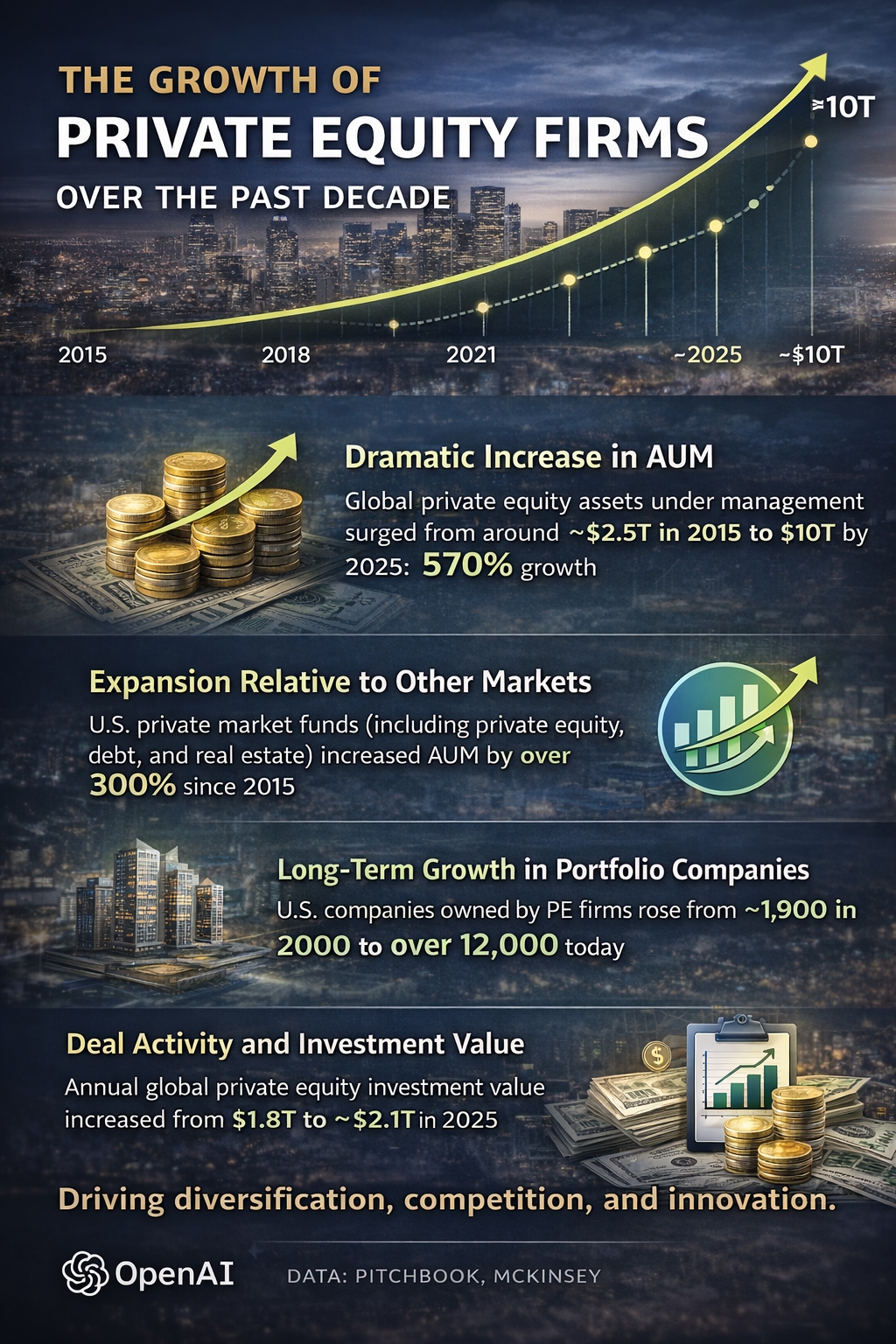
Continued Growth of Private Equity Firms is the reason we have created an institutional desk and allocated a significant block of capital to service our Private Equity Partners’ CAPEX needs.
Dramatic Increase in Assets Under Management (AUM) – Global private equity assets under management have grown substantially over the past decade, rising from around $1.48 trillion in 2010 to nearly $10 trillion by 2025, representing a more than 570% increase in total AUM over that period. This reflects a significant expansion in capital flowing into private equity globally.
Expansion Relative to Other Markets – Over the same period, private markets overall have experienced significant growth—U.S. private market funds increased their total assets by over 300% since 2015. While this metric includes private debt and real estate, it underscores the broader trend of institutional capital shifting into private market strategies, including private equity.
Long-Term Growth in Portfolio Companies – Backing this growth in capital deployment, the number of U.S. companies owned by private equity firms has climbed sharply, from roughly 1,900 in 2000 to over 12,000, underscoring the industry’s expanding footprint in the corporate landscape.
Deal Activity and Investment Volume – More recently, global private equity investment value rose to about $2.1 trillion in 2025, up from $1.8 trillion a year earlier. While deal counts have fluctuated, the overall deal value trend reflects upward momentum in capital deployment even as market conditions evolve.
What This Growth Means – In practical terms, for investors and portfolio companies:
- Capital availability has expanded dramatically, allowing firms to pursue larger, more strategic deals.
- Competition for quality assets has increased, lifting valuations and encouraging operational value creation rather than purely financial engineering. The CAPEX leasing facilities greatly enhance operational efficiencies on many levels.
- The industry has diversified into private credit, secondaries, and continuation strategies as firms innovate around capital deployment.
Why Private Equity Firms Partner With Us
PE sponsors come to us because our private equity equipment financing is built around how private equity actually operates, not how a traditional bank thinks it should.
Acquisition Timeline Compatibility
Our experienced, senior credit committee enables fast underwriting and decision-making, often within days for mid-market transactions. For larger projects, we move in weeks, not quarters.
When a deal is closing, and equipment upgrades are required immediately post-close, we align with transaction timing.
Flexibility that doesn't complicate cap tables
Equipment financing from Equipment Leases sits entirely outside your equity structure. There are no warrant requirements, no equity kickers, and no interaction with preferred stock terms or governance agreements.
Our security interest attaches only to the financed equipment and not to anything else. Sponsors can finance significant CAPEX at the portfolio company level without creating any ripple effect at the fund or cap table.
Right of Use Assets
An operating lease is reported on a company’s balance sheet under current accounting standards by recognizing a right-of-use (ROU) asset and a corresponding lease liability at the present value of future lease payments. Unlike finance leases, operating leases generally result in a single lease expense recognized on the income statement on a straight-line basis over the lease term, rather than a separate interest and amortization expense presentation.
No competition with existing credit facilities
We are a bank-complementary lender, not a bank replacement. Our equipment-only collateral means we don't touch the portfolio company's receivables, real property, or other assets, and we don't consume enterprise-level borrowing capacity.
Sponsors can bring us in alongside an existing senior credit facility without triggering covenants or creating lender conflicts. We fill the CAPEX gap; the bank keeps its relationship intact.
Confidentiality in every deal we handle
We understand that discretion isn't optional in PE transactions; it's a baseline expectation. NDAs are available at the outset of any engagement. We work through your deal team or directly with the portfolio company's finance leadership, whichever you prefer, and we don't generate unnecessary contact points or paperwork trails.
When clients work with us, they can focus on running the business and know the financing side is being handled quietly and professionally.
Private Equity Equipment Financing Success Stories
Case Study: PE-Backed Manufacturing Platform Accelerates Growth With $7.5M Equipment Deployment
Investor Profile
Sponsor Type: Middle-Market Private Equity Firm
Investment Strategy: Platform acquisition with add-on growth
Industry Focus: Advanced manufacturing and industrial services
The Challenge
Following the acquisition of a manufacturing platform, the private equity sponsor identified immediate CAPEX needs across multiple facilities. The portfolio company required new CNC machines, automation systems, and material handling equipment to support increased order volume and margin expansion.
Traditional bank financing would have required additional enterprise-level leverage and restrictive covenants, limiting the sponsor’s flexibility for future acquisitions and recapitalization strategies.
The sponsor needed a CAPEX solution that would move at acquisition speed, preserve credit capacity, and keep the capital structure clean.
The Equipment Leases Solution
The sponsor partnered with Equipment Leases to fund $7.5M+ in production equipment across three locations. Equipment Leases structured asset-specific leasing solutions that:
- Isolated equipment financing entirely from senior debt
- Preserved equity capital for future add-on acquisitions
- Matched payment schedules to production ramp-up timelines
- Enabled rapid deployment across multiple sites without operational disruption

The Results
- $7.5M+ in CAPEX deployed without increasing enterprise leverage
- EBITDA margin improvement through automation and production efficiency gains
- Production capacity accelerated within 90 days of funding
- Sponsor equity preserved for strategic acquisitions in the pipeline
By outsourcing CAPEX execution to Equipment Leases, the sponsor strengthened the portfolio company’s operational foundation, maintained full capital flexibility, and improved overall investment returns.
Case Study: Healthcare-Focused PE Firm Scales Diagnostics Platform in Under 60 Days
Investor Profile
- Sponsor Type: Healthcare-Focused Private Equity Firm
- Investment Strategy: Growth equity with operational scale-up
- Industry Focus: Diagnostic labs and medical services
The Challenge
A PE-backed diagnostics platform required rapid deployment of imaging and laboratory equipment to support geographic expansion into high-growth markets. The next equity event was on the horizon, and the sponsor needed a CAPEX solution that would:
- Do not dilute equity or complicate the cap table
- Avoid the delays of traditional bank approval processes
- Keep the portfolio company’s balance sheet flexible ahead of a planned recapitalization
The sponsor could not afford a financing process that lagged behind the expansion timeline.

The Equipment Leases Solution
The sponsor engaged Equipment Leases as the portfolio company’s dedicated equipment leasing and CAPEX partner, funding $4.2M in diagnostic and laboratory equipment across multiple sites.
Equipment Leases structured the financing to:
- Deliver fast approvals aligned with the geographic expansion timeline
- Provide non-dilutive leasing structures that leave the cap table intact
- Include right-of-use flexibility where balance sheet treatment mattered
- Tie asset-specific financing directly to revenue-generating equipment
The Results
- $4.2M in growth-critical equipment deployed in under 60 days
- Expansion completed on schedule with no delays from financing
- Improved cash flow by aligning lease payments with patient volume ramp-up
- Enhanced valuation heading into the planned recapitalization
Equipment Leases enabled the sponsor to scale the portfolio company efficiently and on time, transforming CAPEX from a constraint into a growth driver and positioning the company for a stronger recapitalization.
See more deals we’ve funded across manufacturing, healthcare, energy, and beyond.
Private Equity Equipment Financing Across the Portfolio Lifecycle
Every stage of a portfolio company’s life under private equity ownership brings distinct CAPEX demands. Here’s how equipment financing supports sponsors at each stage of the lifecycle.
Post-Acquisition Equipment Upgrades
The period immediately after a platform close or add-on acquisition is when equipment needs are most urgent and most underfunded. Credit facilities structured at closing are reserved for working capital, integration costs, and future deal capacity. They weren’t built to absorb Day-One CAPEX.
Why sponsors use us here:
- Equipment needs are immediate, but bank exposure limits or facility structures may restrict additional borrowing
- Equipment-only collateral keeps the structure clean
- Fast underwriting aligns with post-close timelines
Common equipment financed:
- CNC machines and production line upgrades
- Automation and material handling systems
- Multi-site facility infrastructure
Operational Scaling During the Growth Phase
When a portfolio company is performing, winning new contracts, and expanding into new markets, the pressure to deploy capital fast is real. But so is the need to protect equity reserved for future acquisitions and sponsor returns.
Equipment financing provides a growth lever that requires neither an equity event nor an amendment to a credit agreement.
Why sponsors use us here:
- Raising equity can be slow and dilutive
- Bank amendments may introduce new covenants or exposure constraints
- Progress funding covers vendor deposits and milestone invoices as they come due, minimizing operational cash drain
- Direct lending capacity up to $100M+ supports meaningful expansion phases
Common equipment:
- Production capacity expansions and automation systems
- Robotics and multi-site infrastructure buildouts
- Specialized manufacturing equipment with structured, progress-funded builds
Equipment Refresh Ahead of Exit
The 12 to 24 months before a planned exit are when operational improvements matter most to valuation. Buyers pay for momentum, and a portfolio company with modern, efficient equipment tells a stronger EBITDA story than one running aging assets.
Equipment financing keeps cash on the balance sheet while demonstrating operational investment. Operating lease structures can also minimize balance sheet impact when buyers are scrutinizing leverage and asset quality.
Why sponsors use us here:
- Preserves cash reserves heading into a transaction
- Operating lease structures reduce balance sheet impact
- Demonstrates operational momentum to prospective buyers
- Structured around the exit timeline, not just the equipment needed
Common equipment:
- Automation and quality control systems
- Facility modernization and operational efficiency upgrades
- Production line refresh
Operational Scaling During the Growth Phase
When a portfolio company is performing, winning new contracts, and expanding into new markets, the pressure to deploy capital fast is real. But so is the need to protect equity reserved for future acquisitions and sponsor returns.
Equipment financing provides a growth lever that requires neither an equity event nor an amendment to a credit agreement.
Why sponsors use us here:
- Raising equity can be slow and dilutive
- Bank amendments may introduce new covenants or exposure constraints
- Progress funding covers vendor deposits and milestone invoices as they come due, minimizing operational cash drain
- Direct lending capacity up to $100M+ supports meaningful expansion phases
Common equipment:
- Production capacity expansions and automation systems
- Robotics and multi-site infrastructure buildouts
- Specialized manufacturing equipment with structured, progress-funded builds
How We Work With Your Portfolio Companies
We operate with clarity, speed, and structure. Sponsors know exactly what to expect, and portfolio companies know what to prepare.
Documentation Requirements
We begin with a clear checklist to prevent delays. Most transactions require:
- Last 2–3 years of financial statements
- Current interim financials
- Equipment quote or vendor invoice
- Corporate documents (articles, operating agreement, proof of signing authority)
- Ownership details
- Additional supporting documents, depending onthe structure
For larger or multi-entity transactions, we may request additional documentation to confirm authority, structure, and repayment capacity. When companies are prepared, approvals move quickly.
Each Customer Journey is Unique
Speed is a core part of our model.
Every borrower enters the process with different capital needs, timelines, credit profiles, and growth objectives.
Solutions are structured around the specific equipment, industry dynamics, and transaction size involved.
Underwriting and deal execution are tailored to align with each client’s operational and financial strategy.
The goal is not a one-size-fits-all product, but a customized capital approach that supports long-term partnership and portfolio growth.
For progress-funded projects, disbursements align with vendor milestones. Deposits and stage payments are handled as invoices come due.
Credit Considerations
We evaluate the full credit story, not just a single metric.
Key areas reviewed:
- Historical and projected cash flow
- Revenue consistency and growth trends
- Industry profile and equipment resale market
- Existing bank exposure limits
- Legal authority and corporate structure
Our underwriting is direct and disciplined. We finance both bankable and bank-limited companies when the structure supports responsible repayment.
The equipment serves as primary collateral. We focus on asset-backed structures rather than blanket liens across the business whenever possible.
Communication Protocol
We typically work directly with the portfolio company’s CFO or finance lead.
When sponsors are involved, we coordinate transparently and keep key stakeholders aligned on structure, timing, and documentation requirements.
Our credit process is not adversarial. It is structured, checklist-driven, and transparent, designed to move quickly while protecting all parties involved.
Industries We Finance
We work across capital-intensive sectors where equipment drives enterprise value.
Advanced Manufacturing
Production lines, CNC machining, automated systems, precision fabrication, and facility-wide infrastructure upgrades.
Manufacturing is one of our highest-volume sectors. We understand how incremental capacity translates directly to revenue growth and EBITDA expansion and we structure financing accordingly.
Medical Technology & Diagnostics
Imaging systems, CT scanners, laboratory equipment, surgical center buildouts, and clinical infrastructure.
We finance full projects, including installation, shipping, and warranties, so healthcare operators can deploy equipment and begin billing without delay.
Pharmaceutical & Life Sciences
Domestic manufacturing builds controlled production environments and specialized pharmaceutical production equipment.
As reshoring initiatives have accelerated U.S. manufacturing investment, we have structured financing to support rapid capacity deployment under compressed timelines.
Construction & Industrial Services
Heavy equipment, specialty machinery, fleet assets, and production-support equipment.
We support both platform-level fleet financing and targeted equipment additions tied to expansion or acquisition activity.
Power Generation & Energy
Renewable infrastructure, turbines, and generation equipment.
We have financed projects where energy upgrades materially reduced operating costs, the type of operational improvement that strengthens margin ahead of recapitalization or exit.
Food Processing & Packaging
Commercial production lines and automated packaging systems.
We understand contract-driven timelines in food manufacturing. When equipment must be operational to fulfill supply agreements, speed and structured funding matter.
Transportation
Fleet vehicles and specialized transport equipment supporting distribution expansion and operational scaling.
Aviation
Aircraft, engines, and related operational equipment.
We finance aviation assets for companies requiring capital to acquire, upgrade, or refinance mission-critical equipment.
For a broader overview of the types of assets we finance, visit our Industries & Equipment We Finance page.
Frequently Asked Questions
Does your equipment financing affect our senior credit facility?
Our financing is secured primarily by the equipment being financed. We focus on asset-backed structures rather than blanket liens across receivables or enterprise assets. The structure is designed to complement existing credit arrangements, not compete with them.
How fast can you move on a deal tied to an acquisition timeline?
For transactions in the $100K–$500K range with a complete financial package, we typically issue an indication within 24–48 hours.
Multi-million-dollar or complex transactions, including multi-vendor builds or large-scale deployments, generally move through underwriting in approximately 10–14 days, and up to 3–4 weeks for very large deals.
If you have a hard deadline, tell us upfront. We will give you a direct answer on timing.
Do you work directly with the portfolio company or through the sponsor?
We typically engage directly with the portfolio company’s CFO or finance lead, while keeping sponsors informed as requested.
If your team prefers to centralize communication, we will follow your structure. Our goal is clarity, not additional friction.
Can you support multiple portfolio companies simultaneously?
Yes. We operate as a direct lender with internal underwriting and documentation teams, allowing us to run parallel transactions across multiple companies.
If your portfolio has recurring equipment needs, we can coordinate a structured referral workflow.
Do you work with companies that have reached bank exposure limits?
Yes. We regularly work with companies that are profitable and bankable but constrained by internal exposure caps or covenant structures.
Our equipment-focused financing can provide additional CAPEX capacity without requiring a full credit facility amendment.
Start a PE Partnership Conversation
The fastest sponsors already have their equipment financing partner in place before CAPEX pressure hits.
Whether you have an active portfolio need or want to strengthen your capital toolkit for future deals, let’s connect.
Active Deal Review
Share the portfolio company, equipment needed, and timeline. We’ll provide a candid assessment within one business day, including fit, structure, and speed.
Standing Partnership
Let’s discuss your portfolio and recurring CAPEX patterns. We’ll outline how we work so that when a need arises, one call is all it takes.